



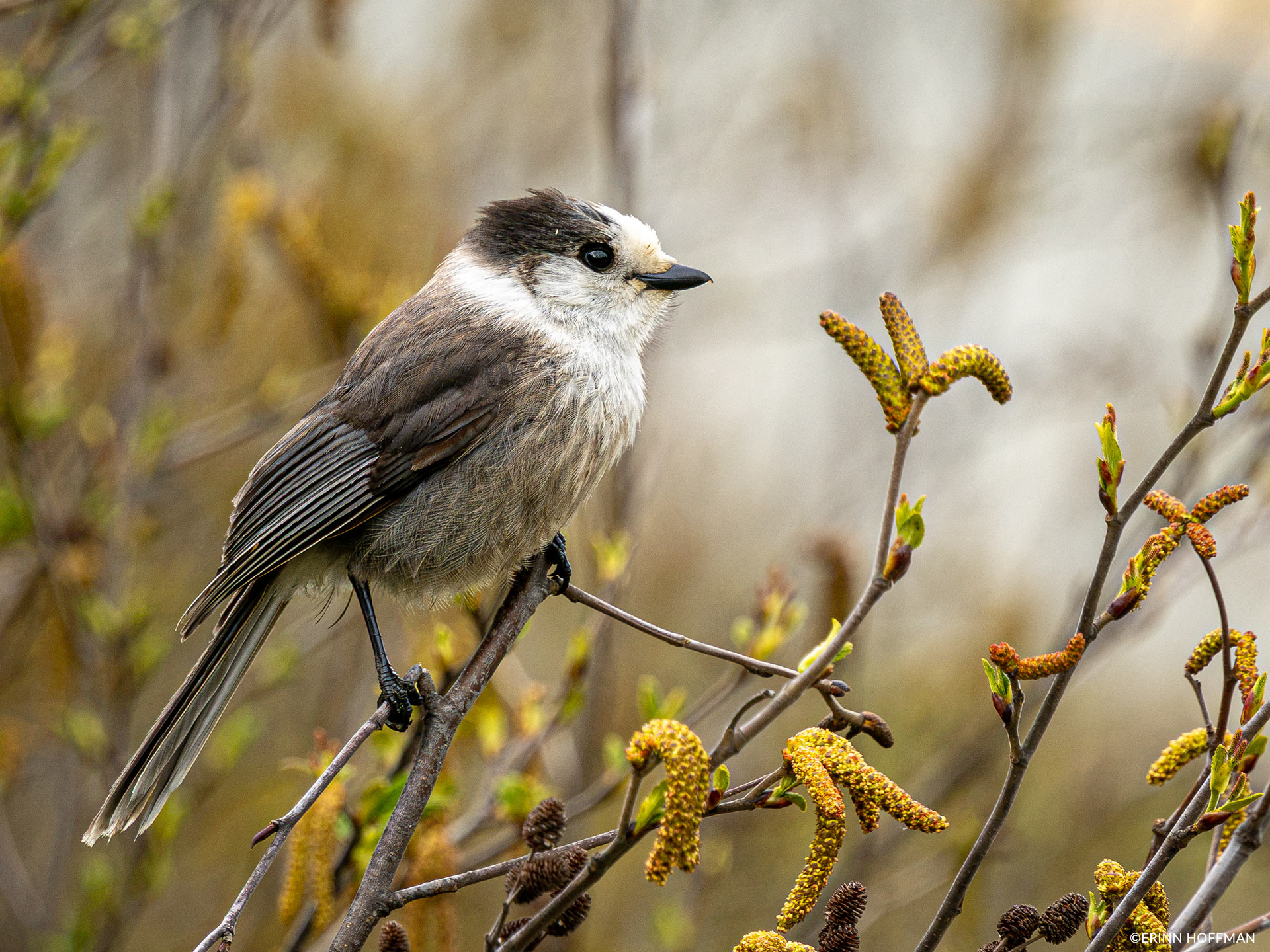
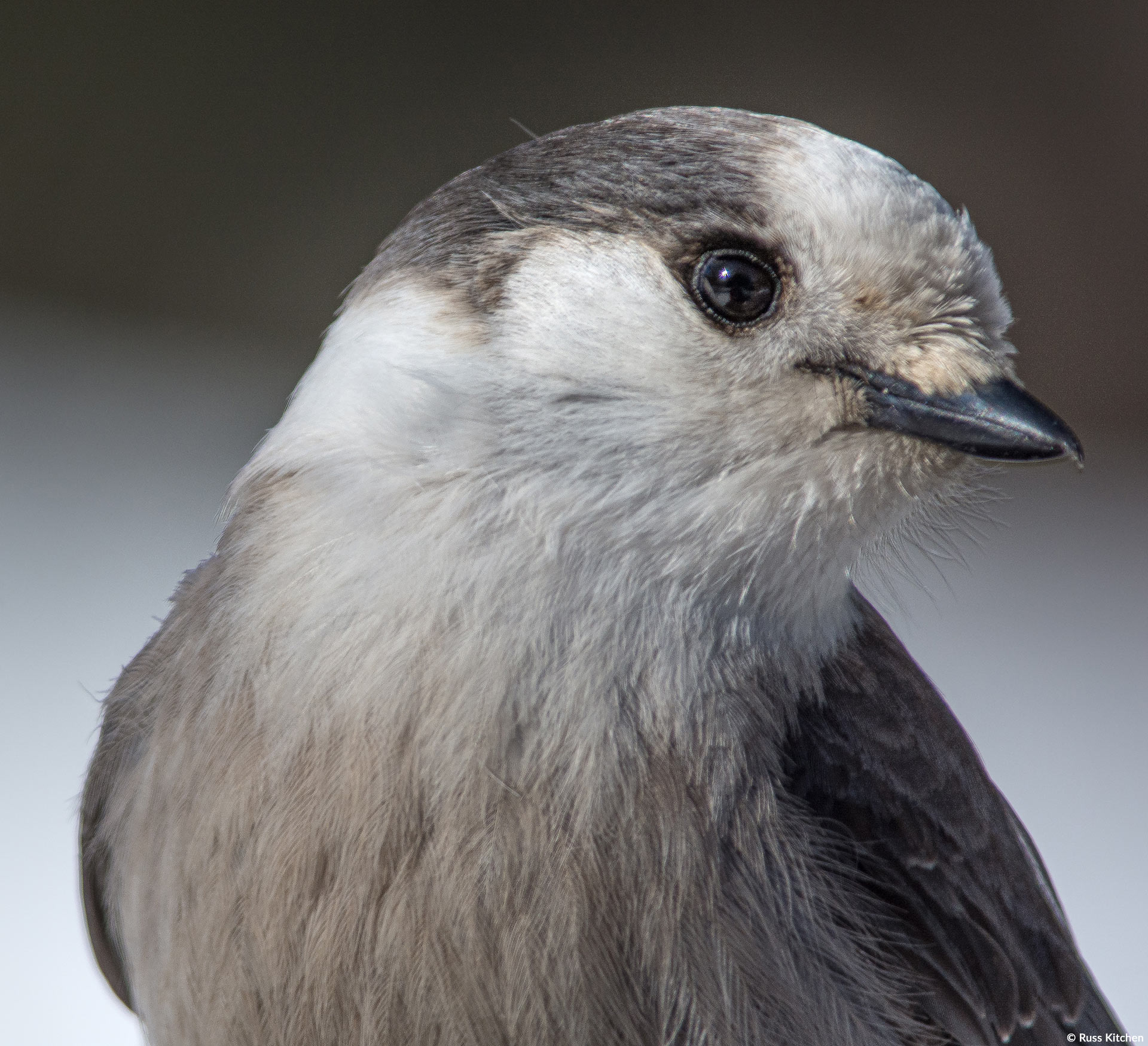
Description
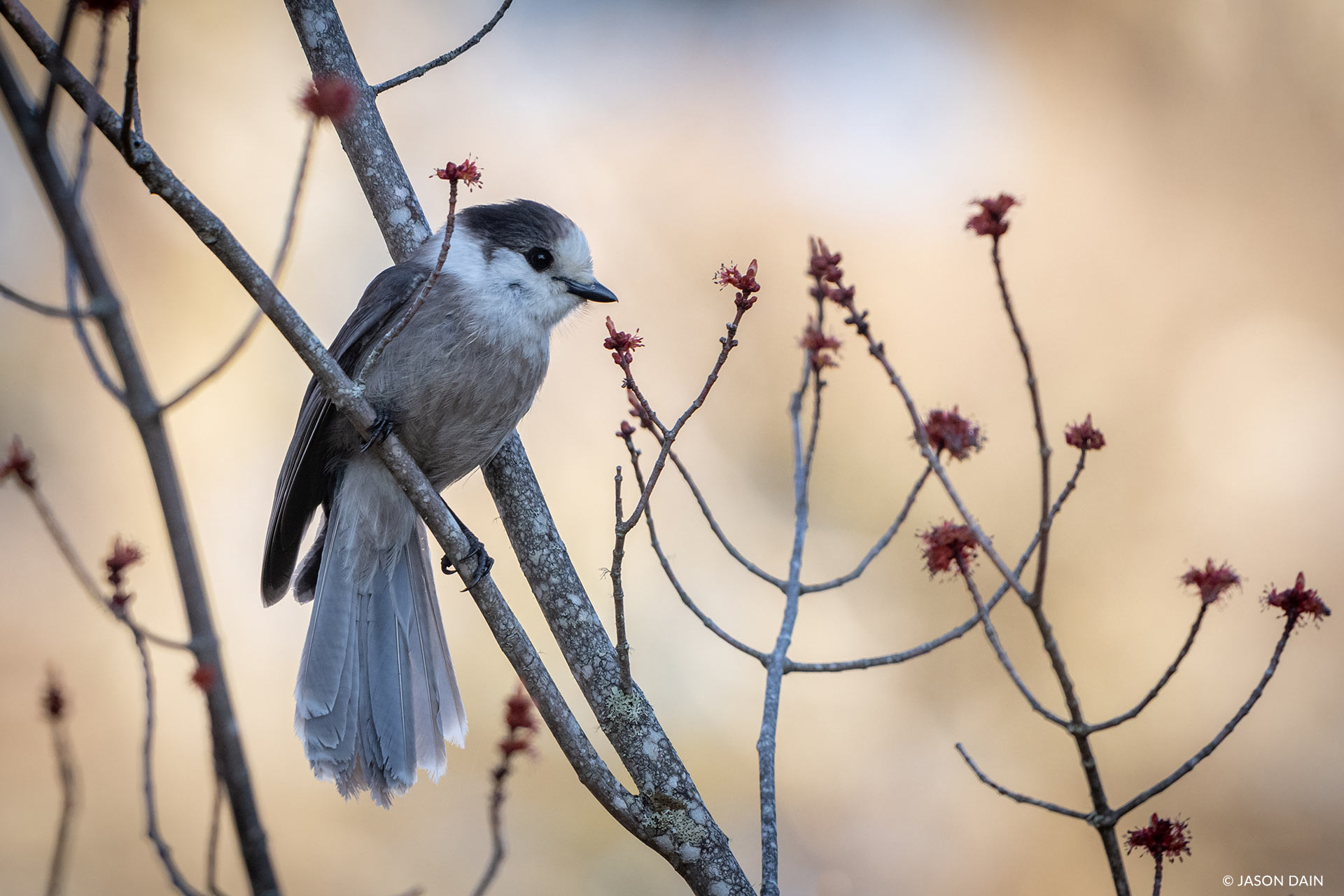 Credit: Jason Dain
The Canada Jay (Perisoreus canadensis) is indelibly associated with the great northern forests in Canada; in 2016, it was proposed to be our official national bird by the Royal Canadian Geographical Society. This view has garnered enthusiastic, coast-to-coast support from ordinary citizens and over 40 provincial and national environmental and conservation organizations. The proposition passed by the Senate in 2026.
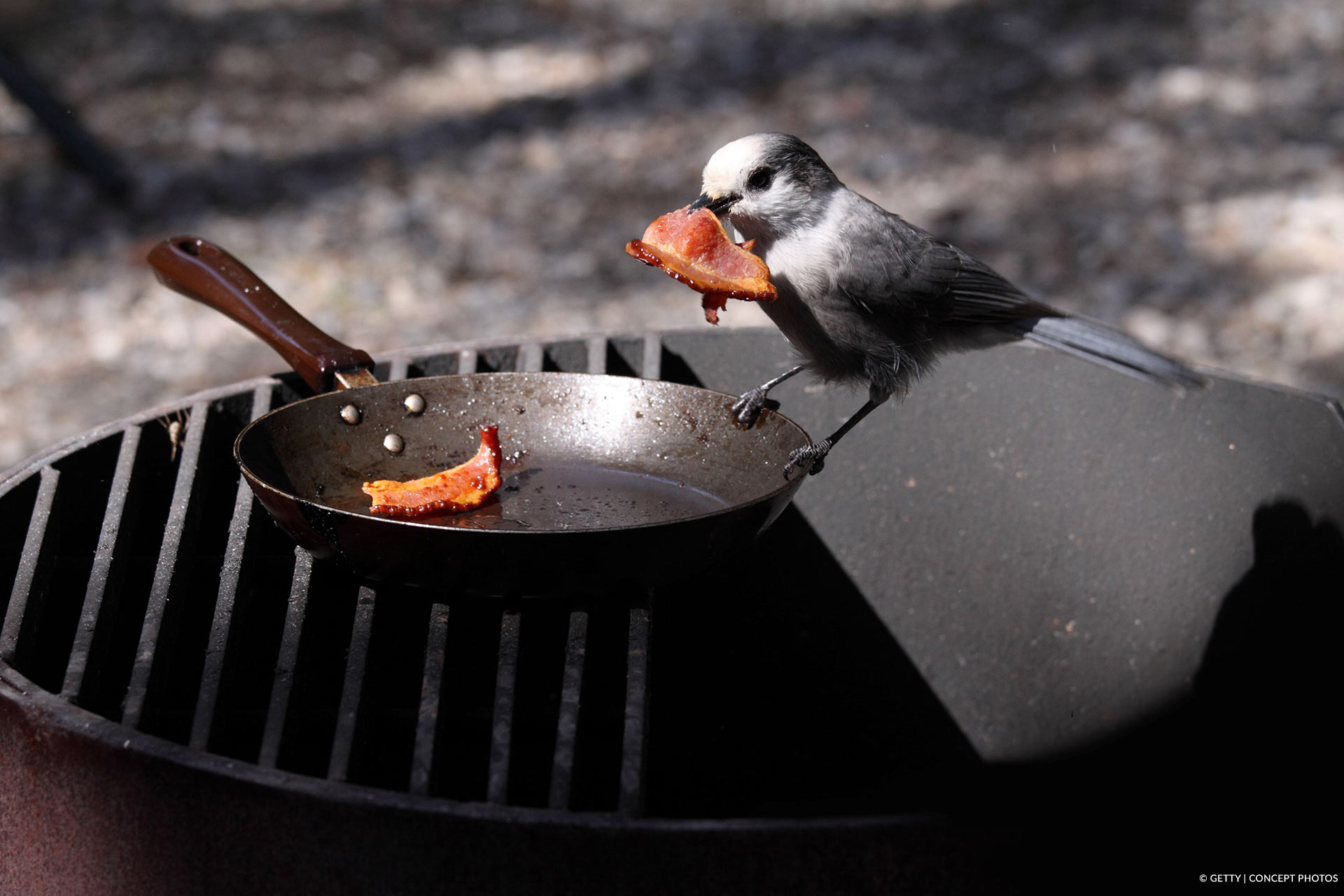
Quick to learn that human activity can be an excellent source of food, the Canada Jay often visits hunters, campers, canoeists and other wilderness travellers looking for scraps of anything edible.
The bird’s fearless and venturesome behaviour has delighted and amused those who work in the forest and earned it more than 30 colloquial names. By far the most common of these is “whiskyjack”, based on a Cree name, wîskicâhk, that passed into English at fur-trading posts around Hudson Bay over 300 years ago. Today, “whiskyjack” is in everyday use from one end of the country to the other, making the Canada Jay the only bird in Canada for which a name of Indigenous origin is commonly used in English.
Although the official name, “Canada Jay”, dates back to at least 1822, from 1957 to 2018 it was known as the “Gray Jay”, a name you may see in older bird books. “Canada Jay” was formally restored as the official English name in 2018.
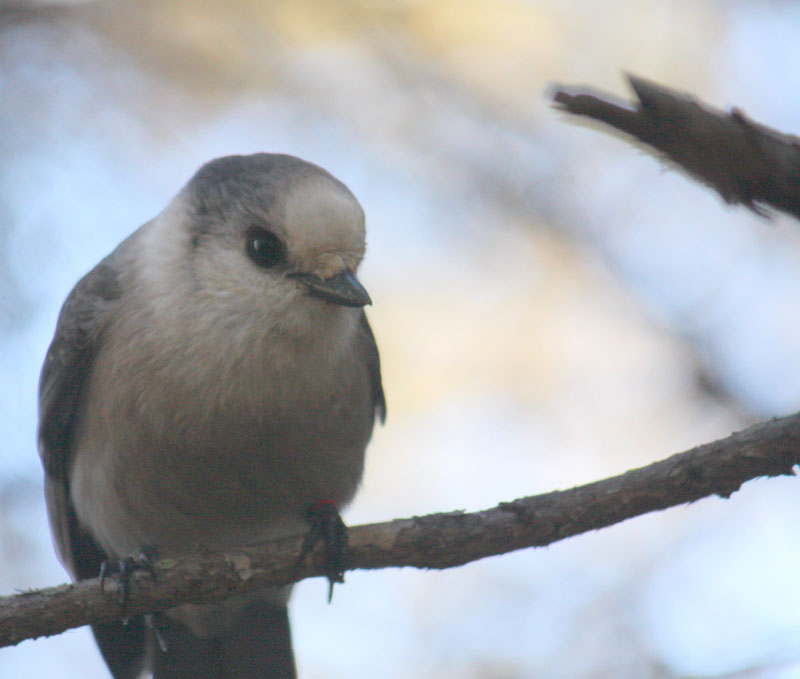
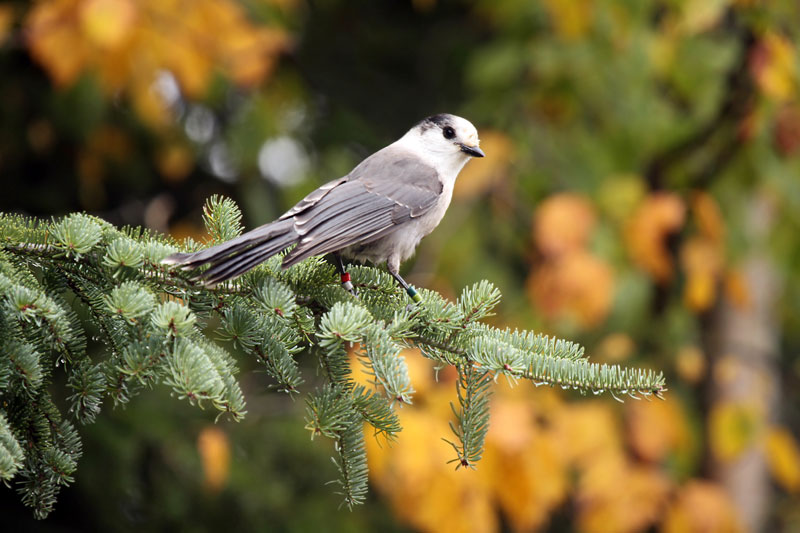
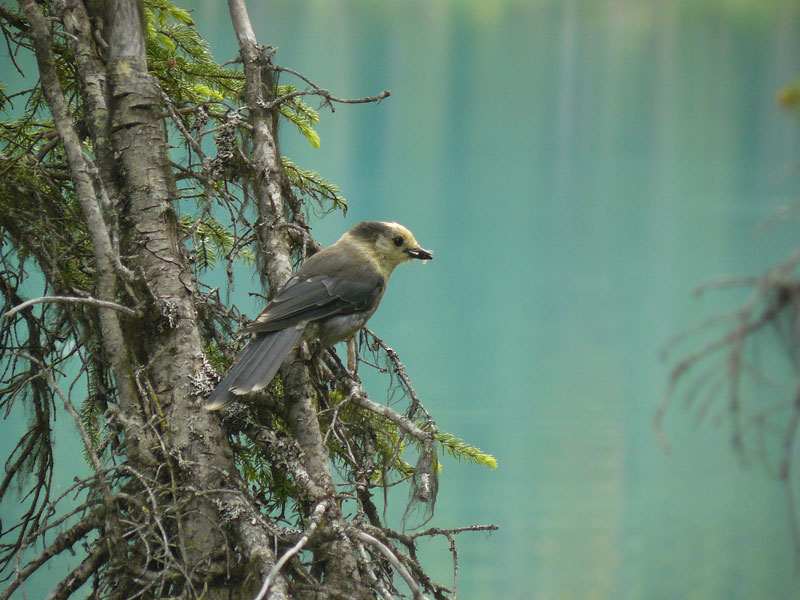
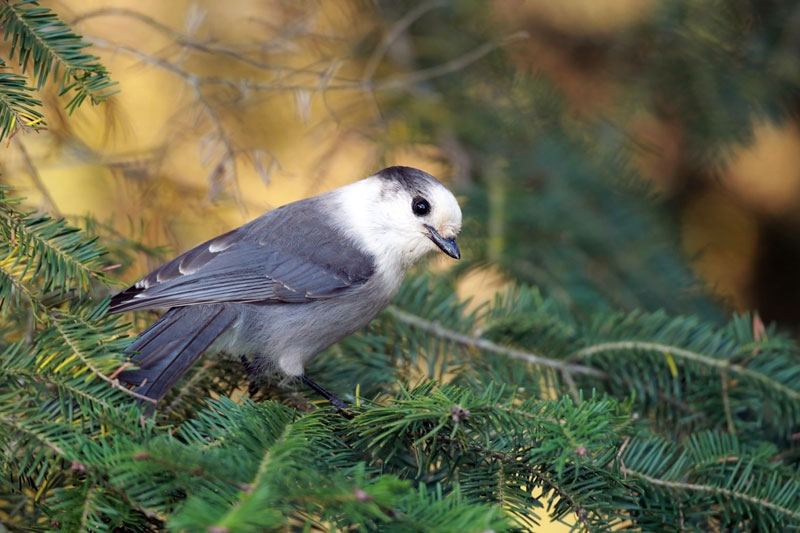
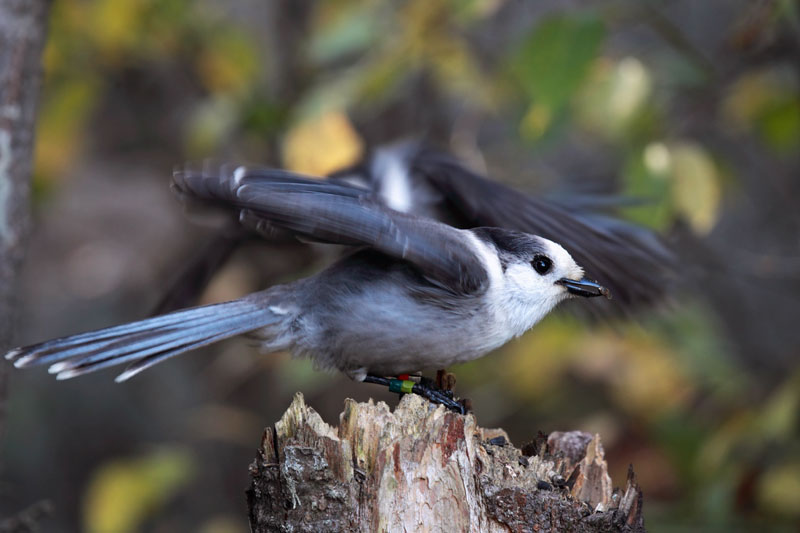
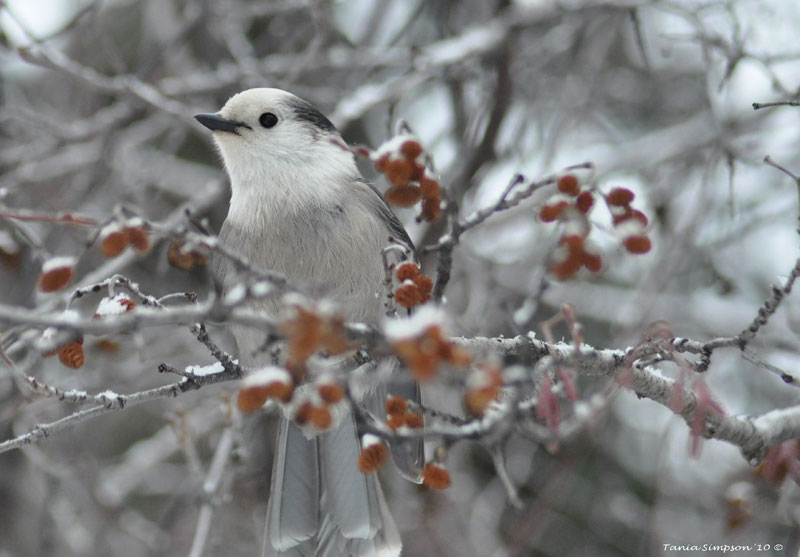
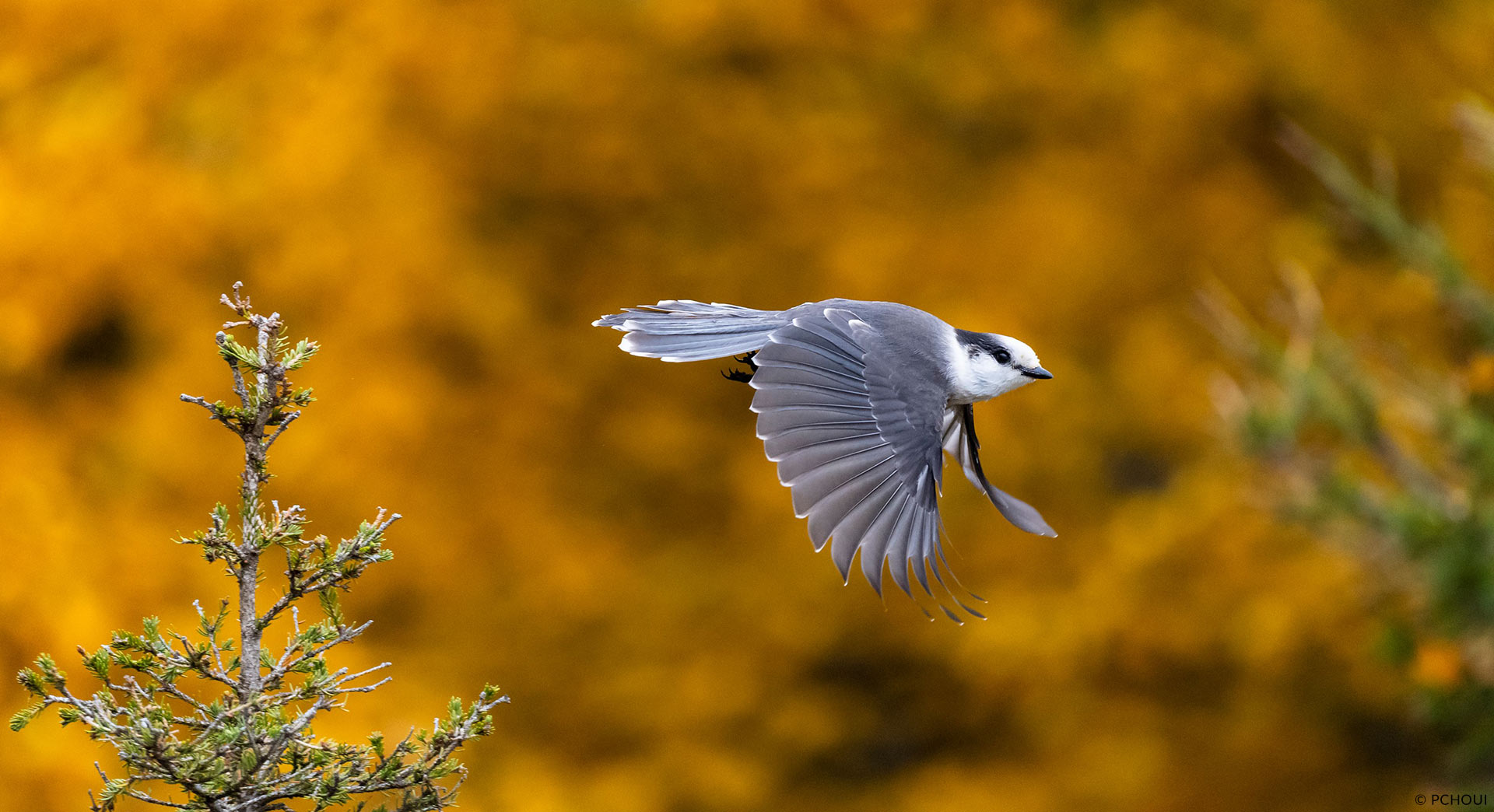
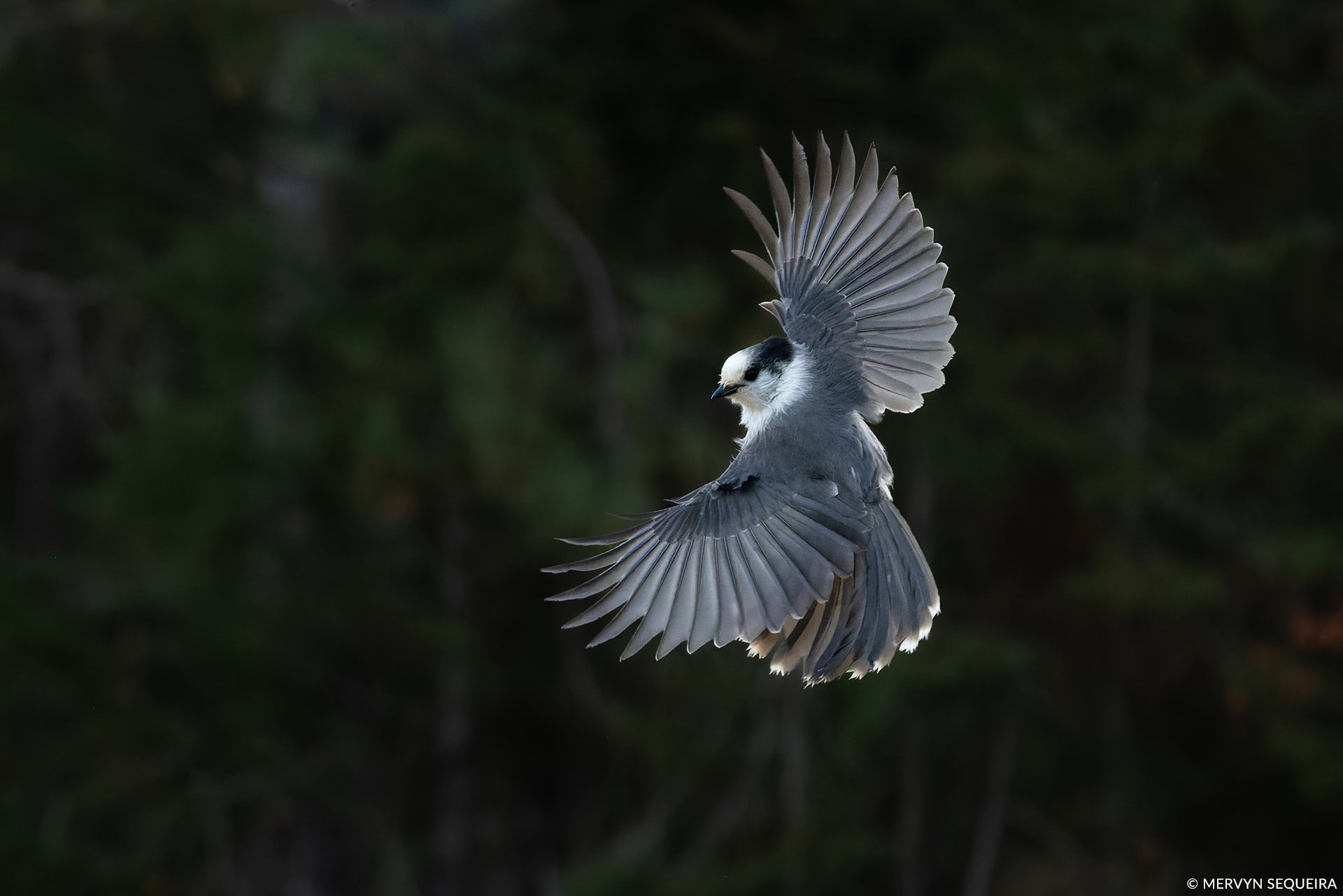
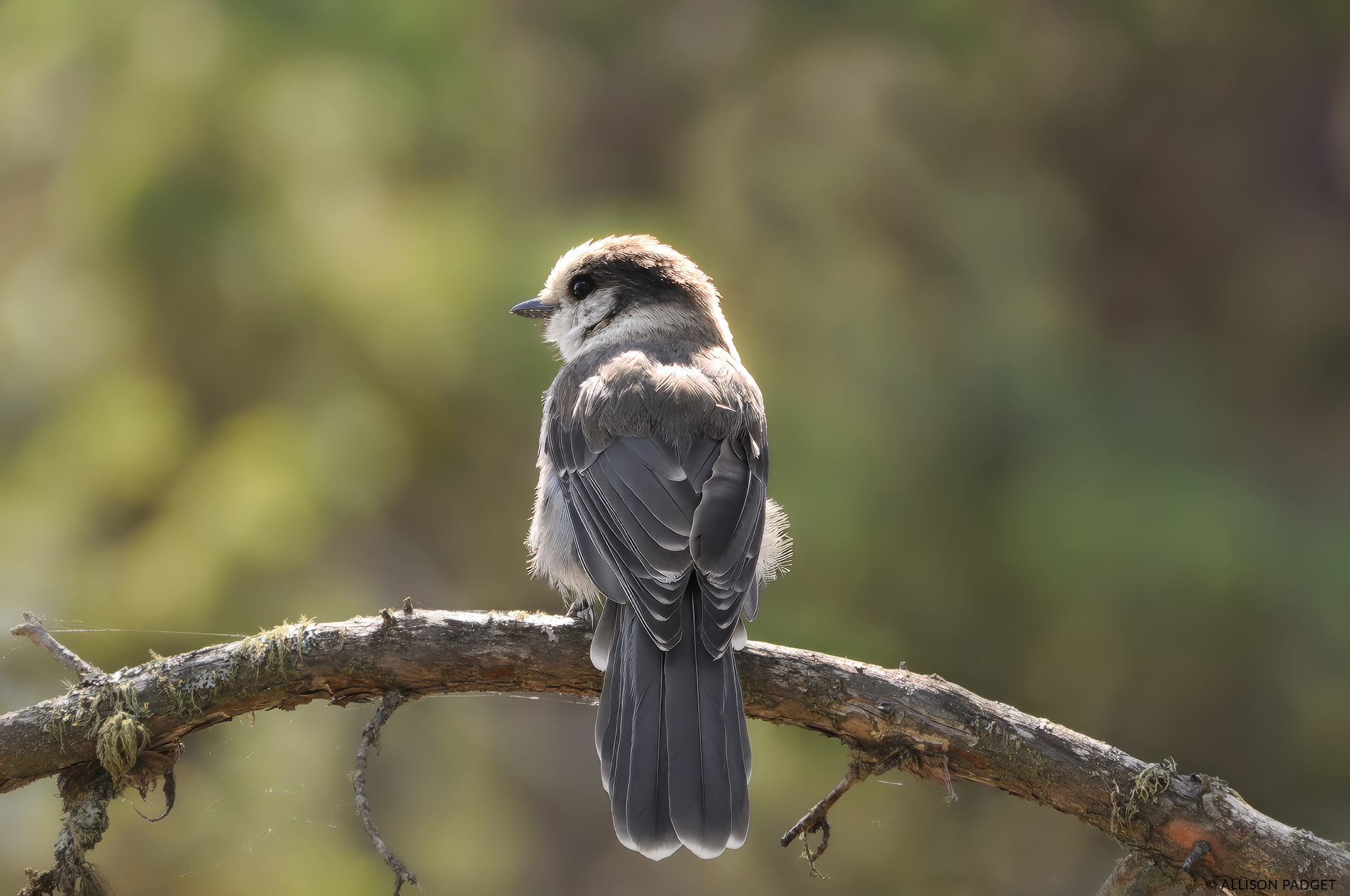
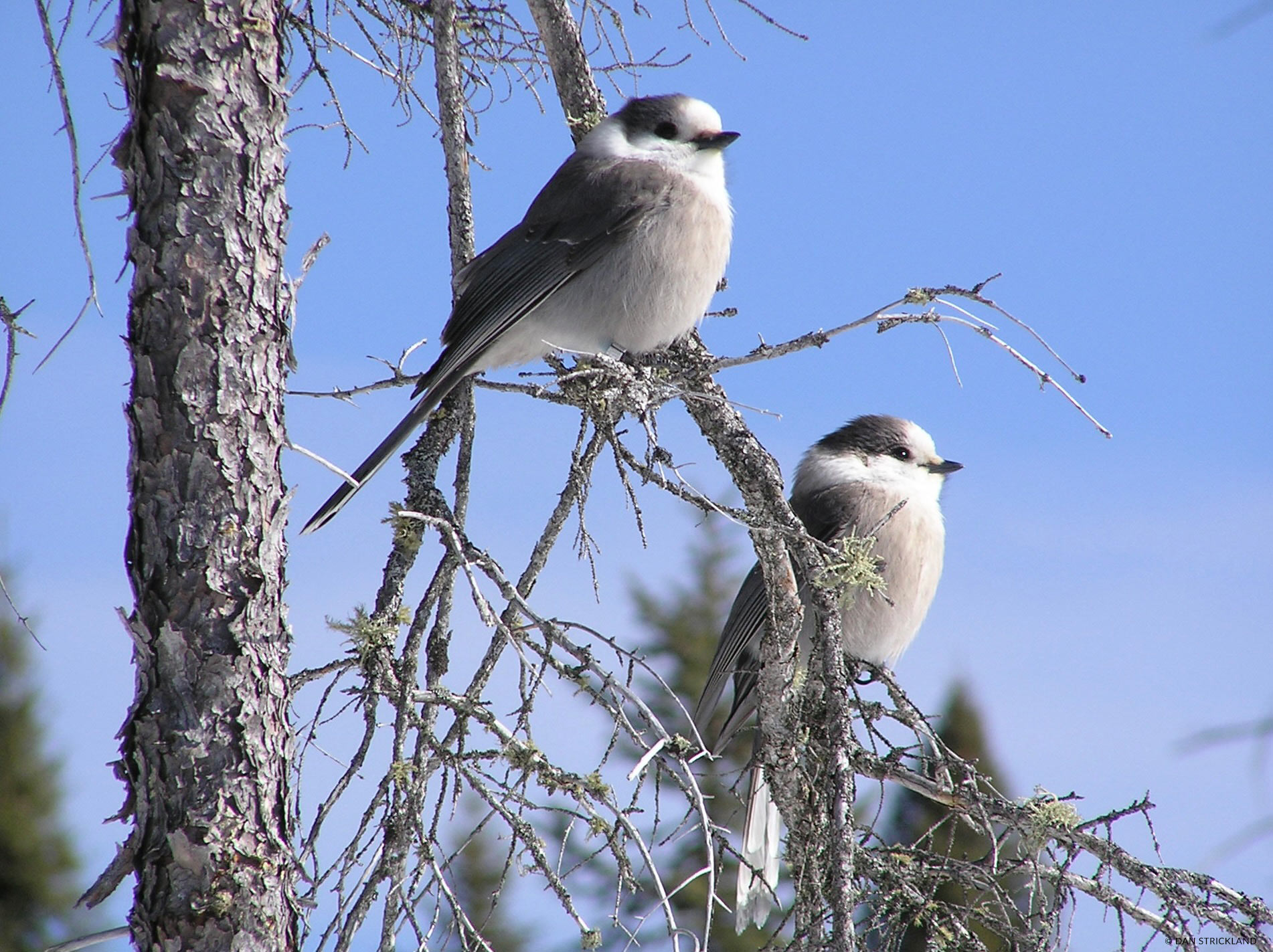
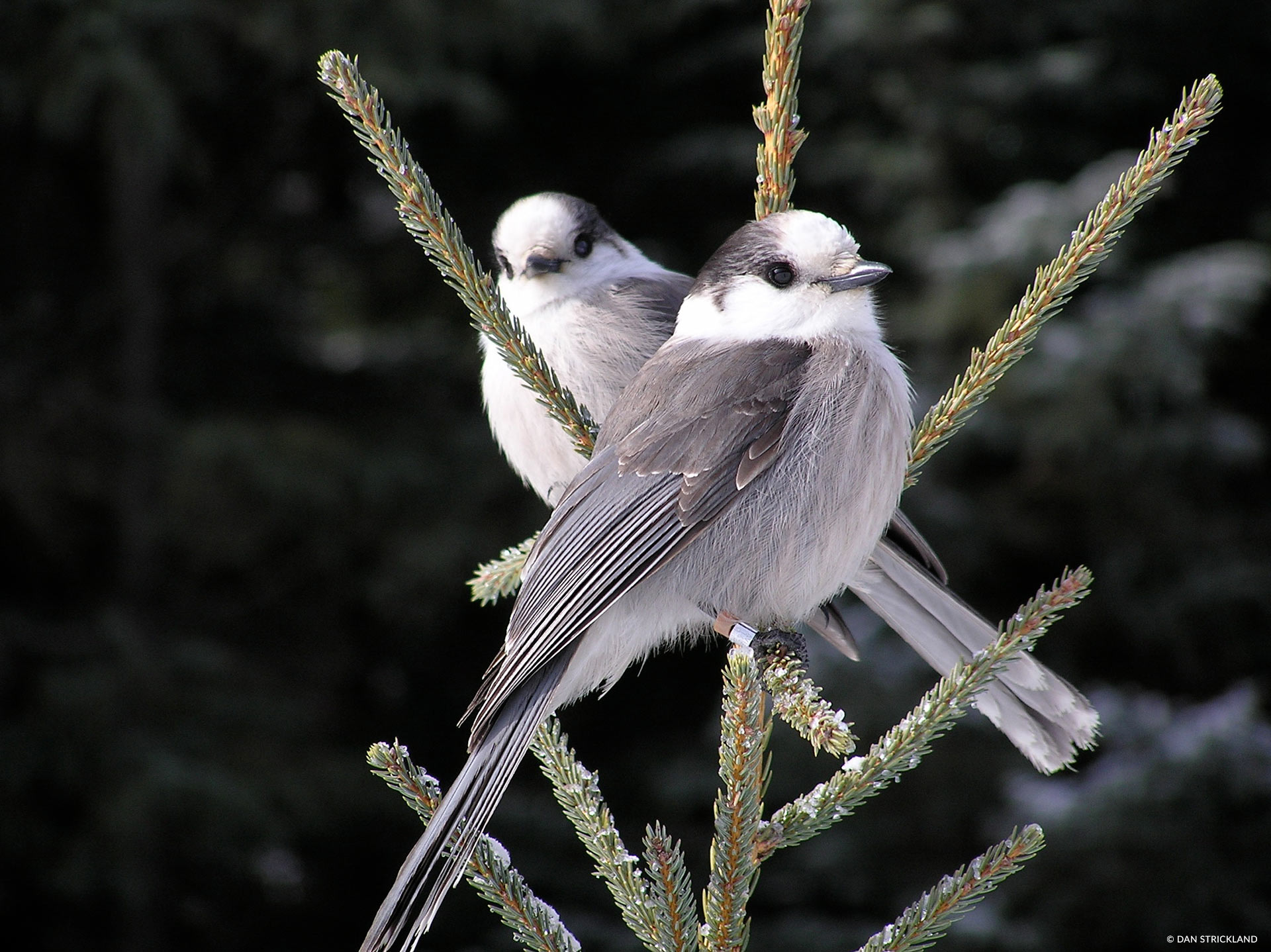
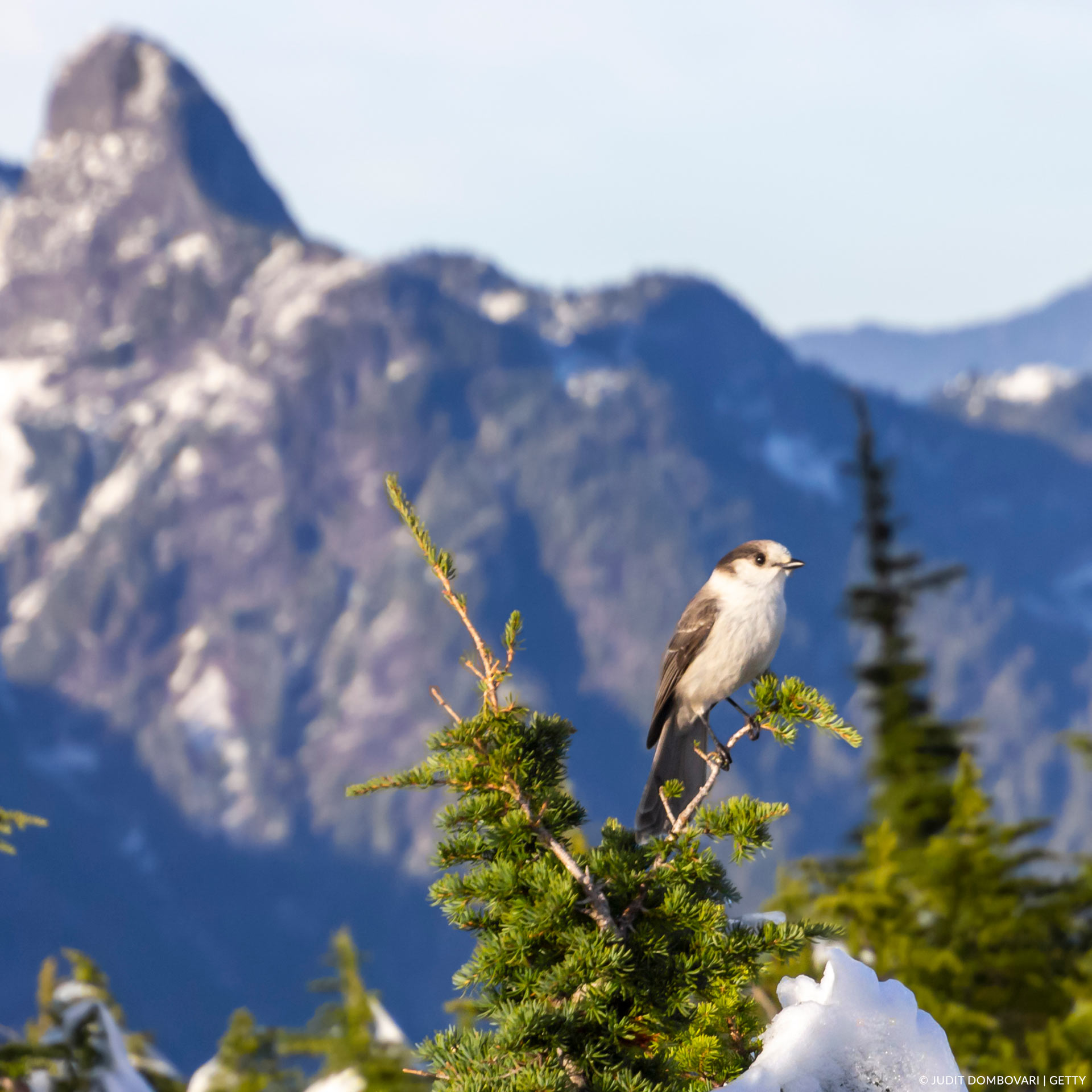
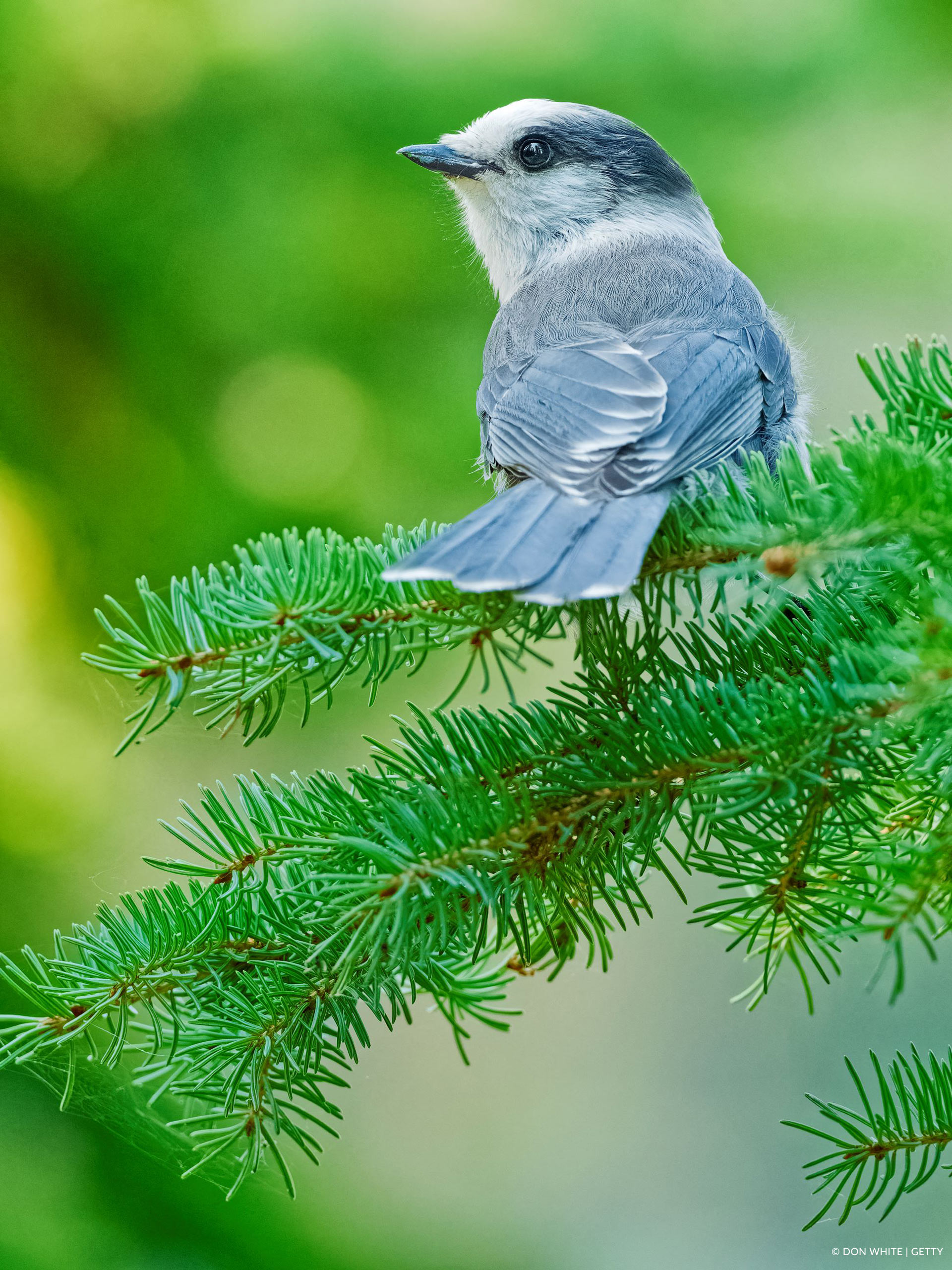
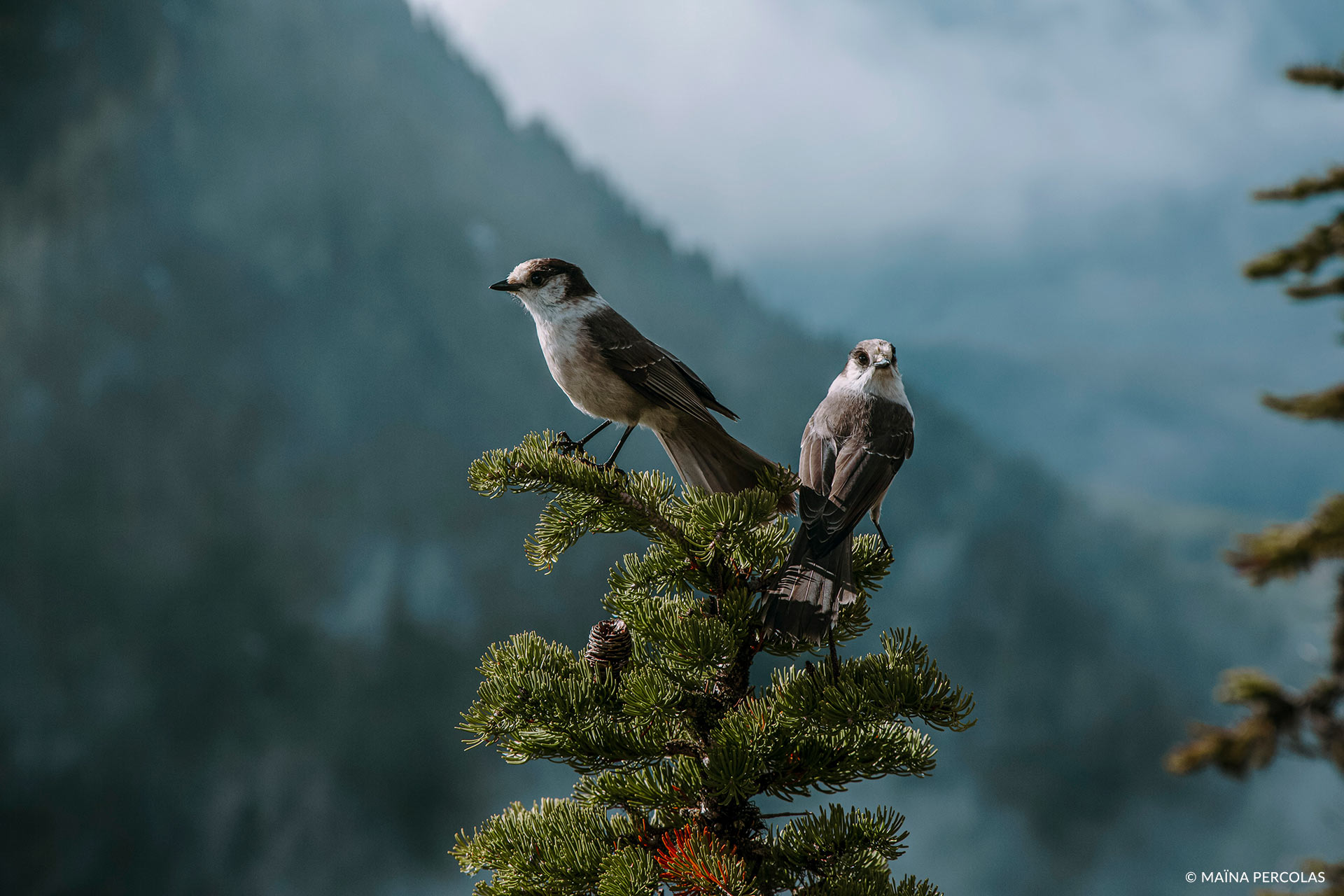
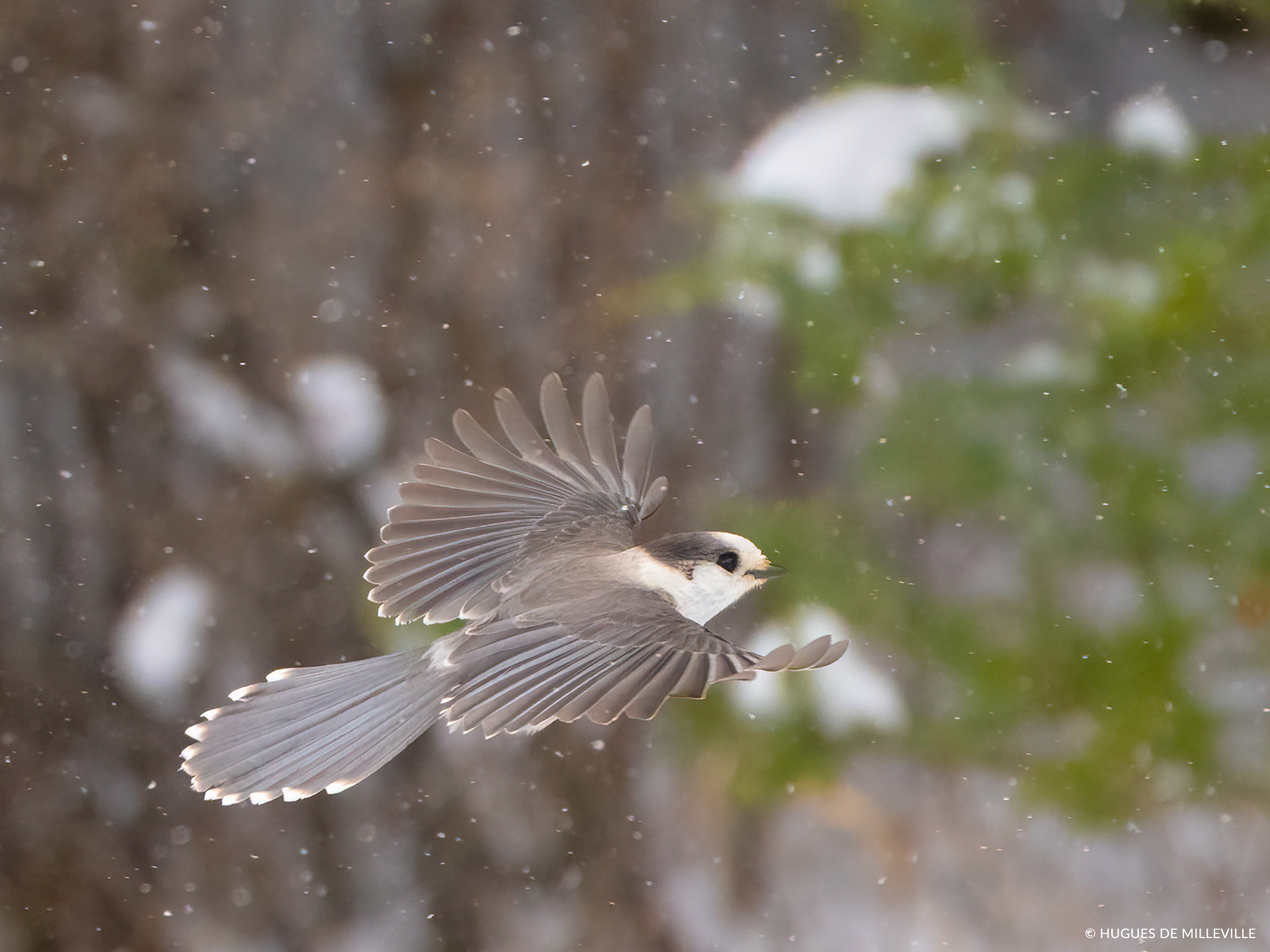
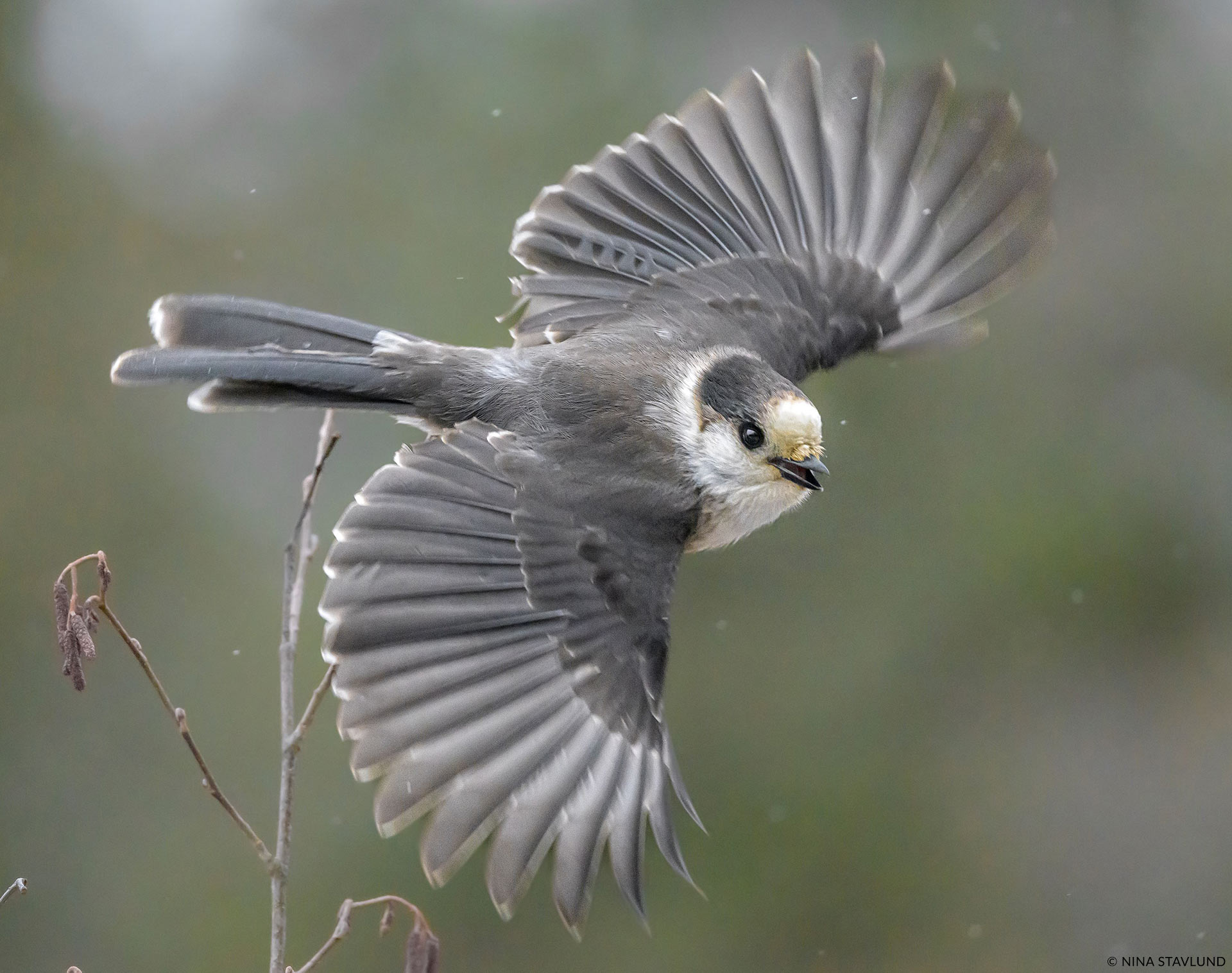
The Canada Jay is only slightly smaller than a Blue Jay and, silhouetted against the sky, the two birds are surprisingly similar, although the Canada Jay is a somewhat a slower and weaker flier than its southern relative. Close up, the Canada Jay can hardly be confused with any other bird. Its back and tail are a medium grey and the underparts a slightly lighter shade, but the head has a striking and unique pattern of black and white. The short, black bill, the large dark eyes, and the thick, fluffy plumage help give the Canada Jay a soft, rounded appearance that most people find highly appealing. For the Canada Jay, of course, the thick plumage is what keeps it warm on long winter nights or in cold snaps when the temperature may be 40 below zero for days at a time.
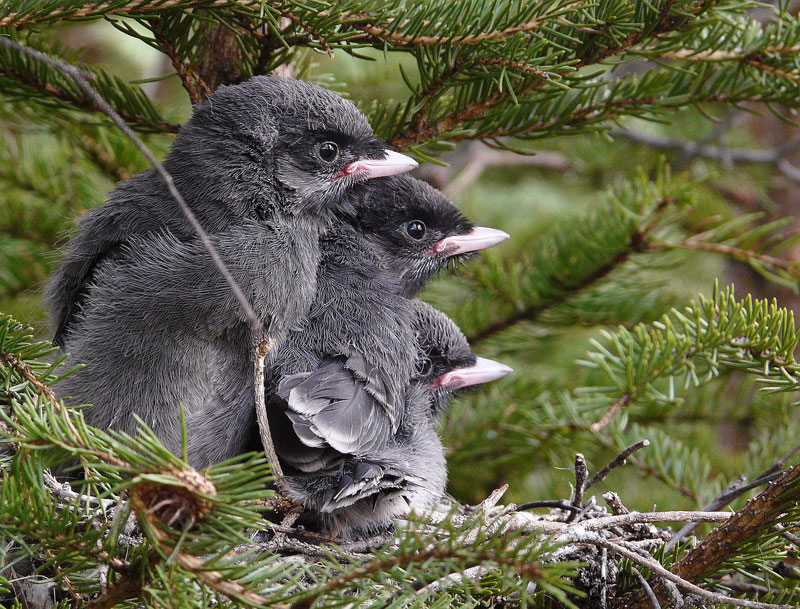
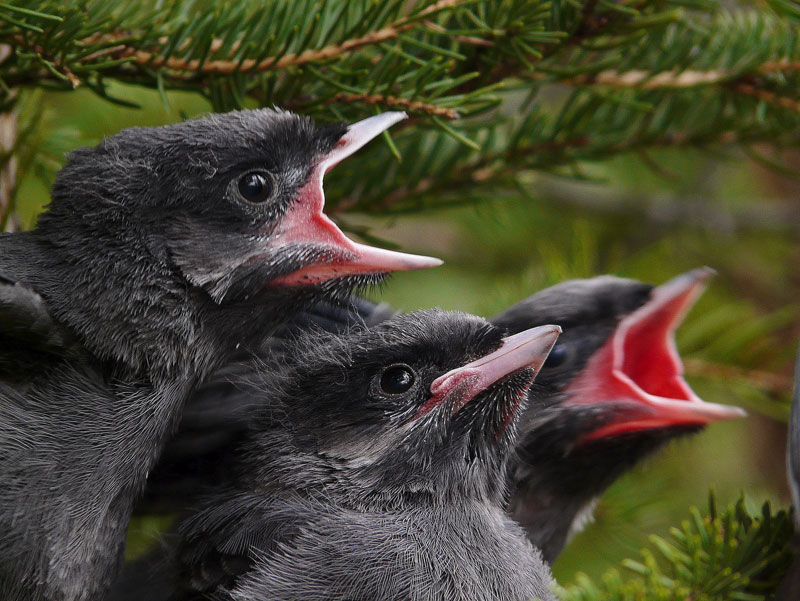
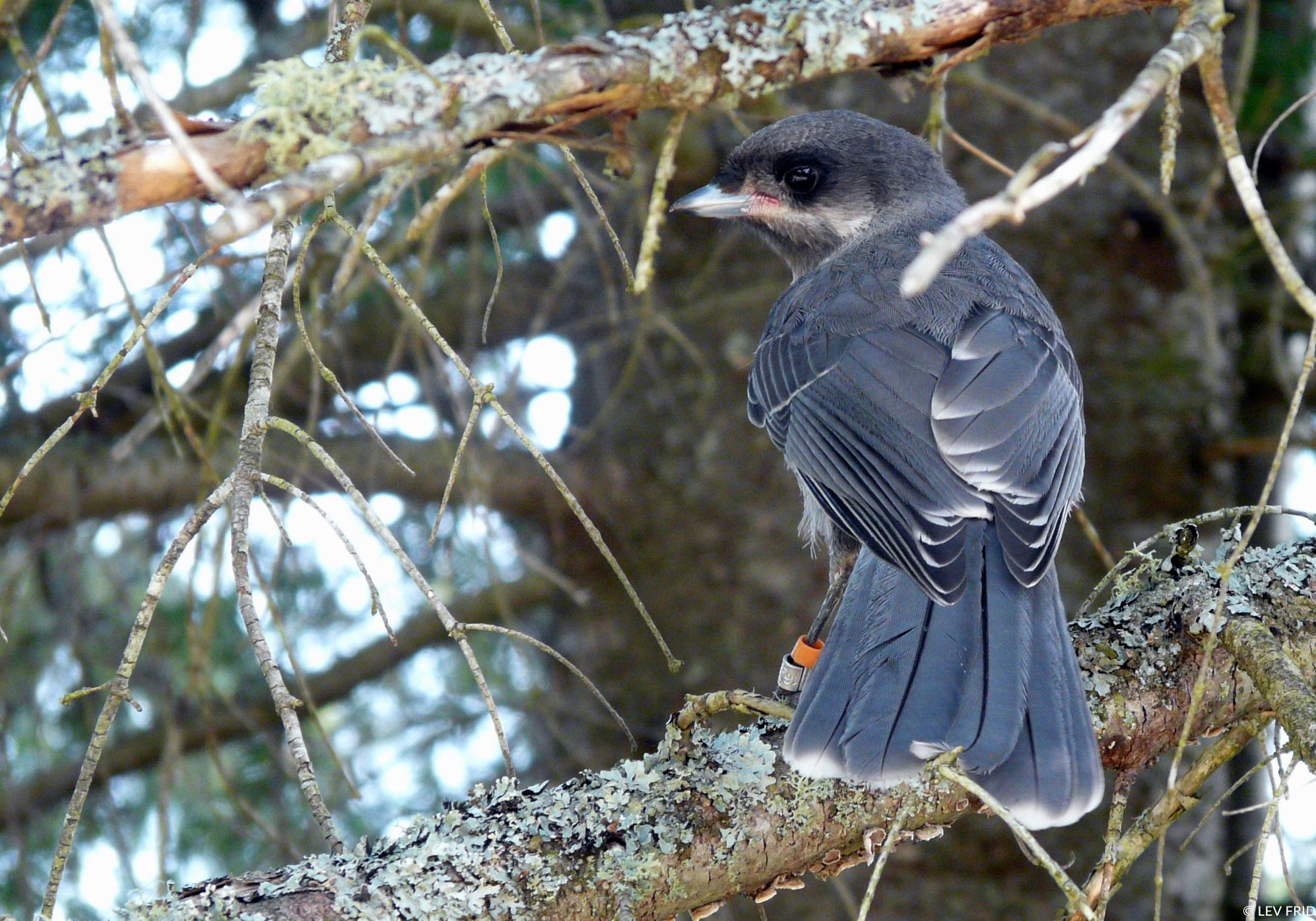
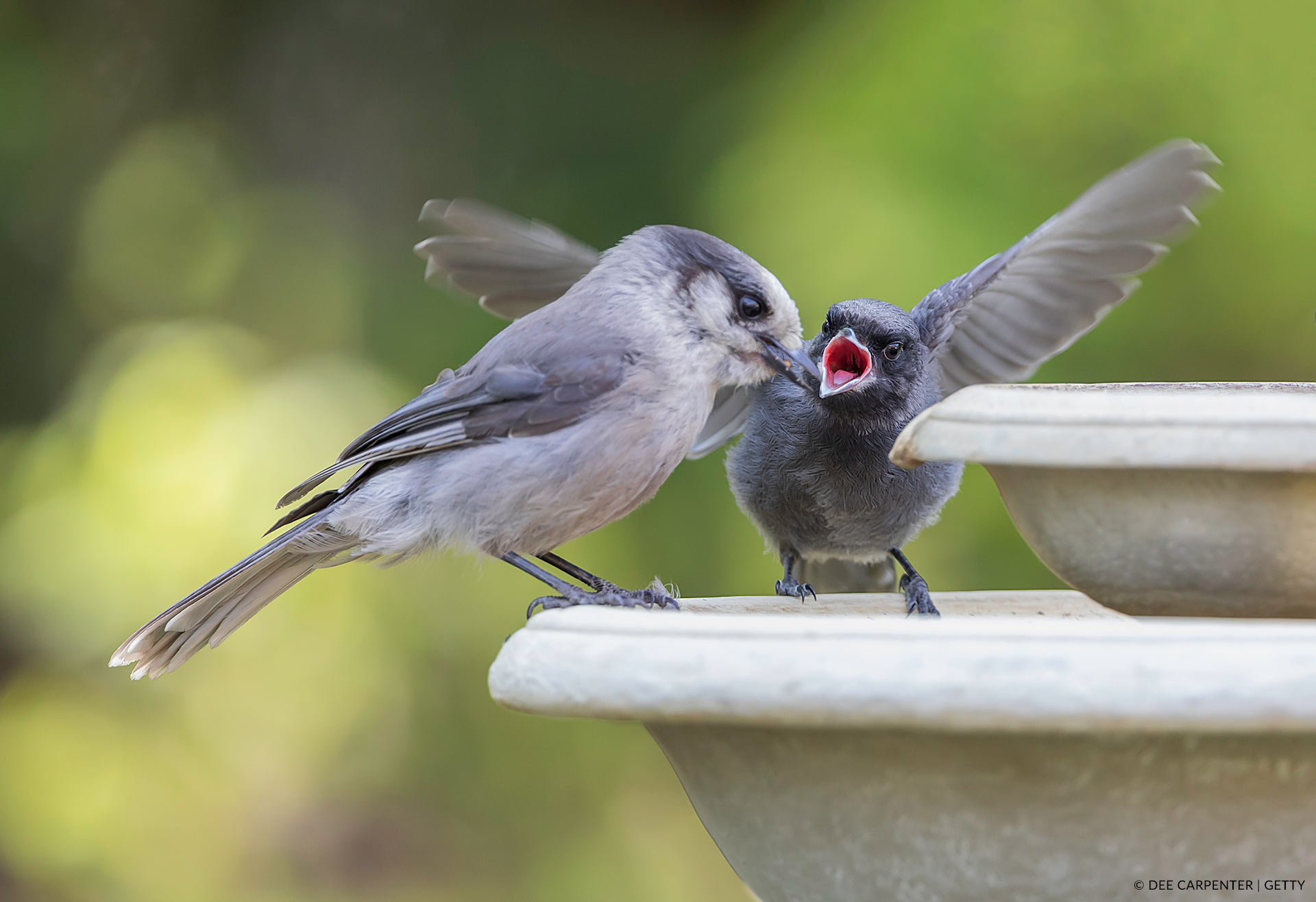
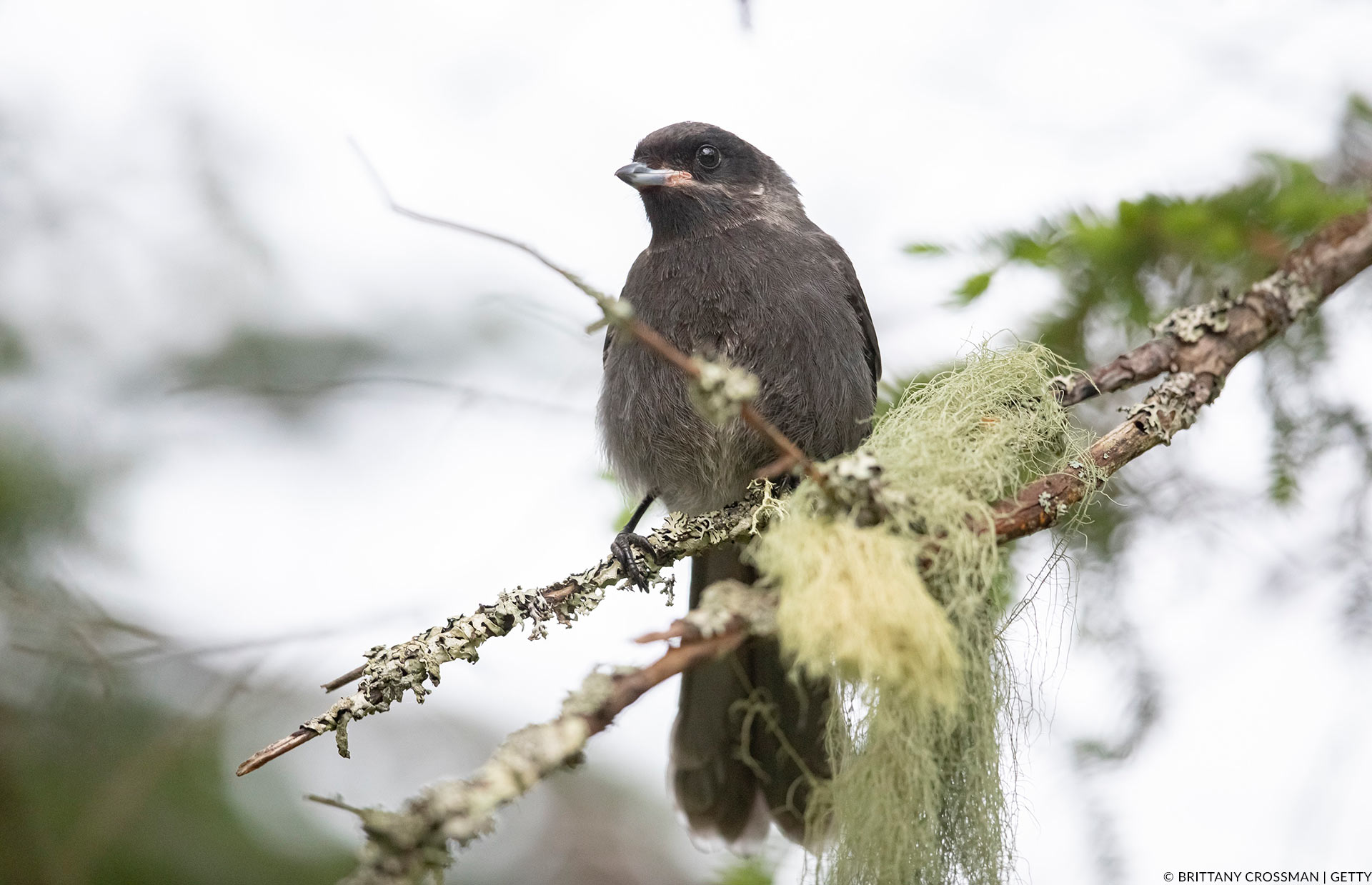
Juvenile Canada Jays just out of the nest look very different from the adults, being a uniform, sooty grey colour all over their bodies. Young and old are so distinct, in fact, that they were at first thought to be different species. Juveniles begin their first moult in July, however, and by the end of August they essentially look just like adults.
Signs and sounds
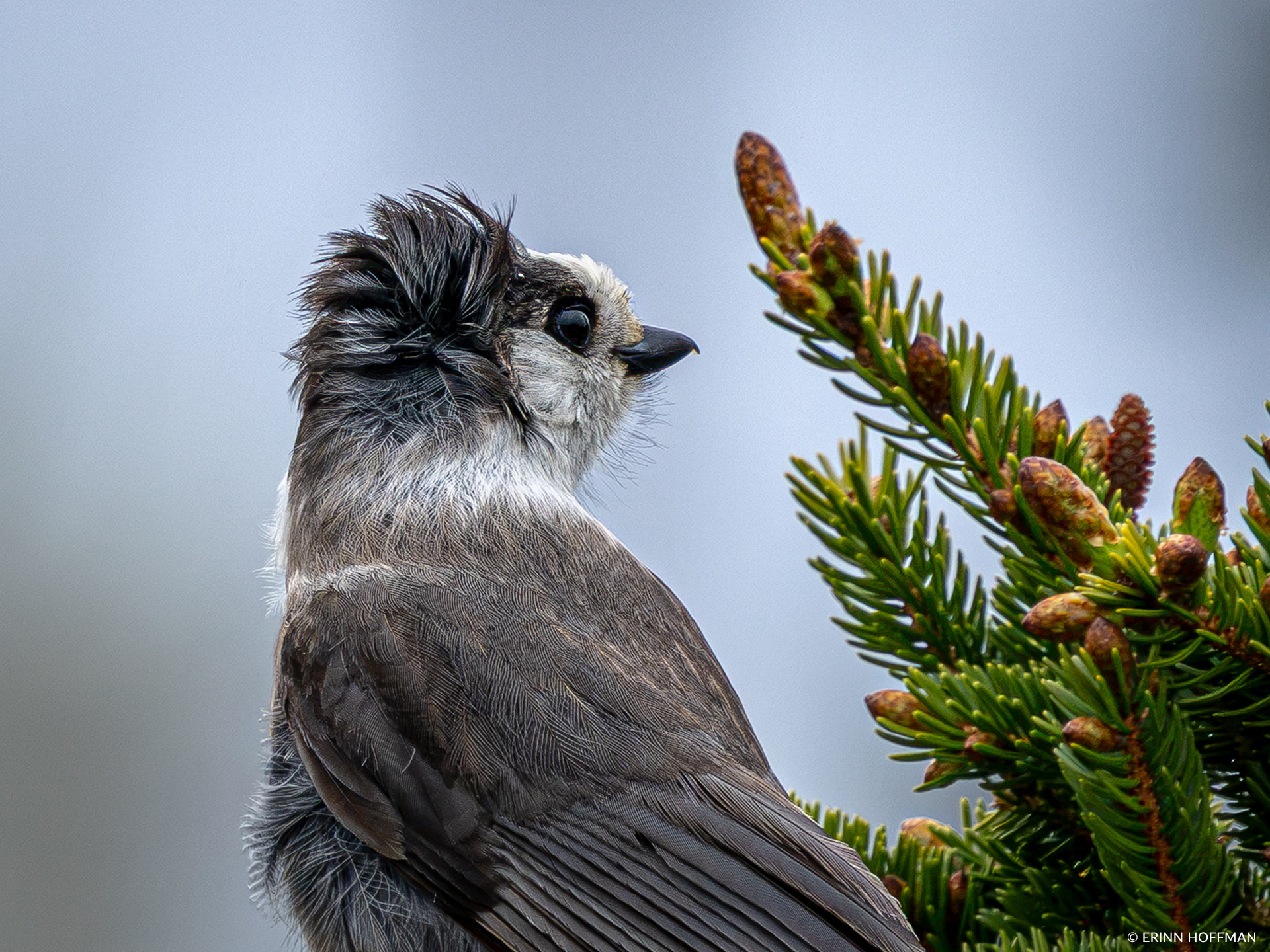 Credit: Erinn Hoffman
The Canada Jay is notably quieter than many members of the crow and jay family but it still has a rich vocal repertoire. Members of a pair or family group moving through the forest frequently give single, quiet twirks or whuits. These are probably contact notes by which each bird in the group keeps track of the others’ whereabouts. A harsh chatter is associated with the mobbing of terrestrial predators and soft repeated whistles, “hoo, hoo, hoo” are given when aerial predators are spotted. Among several vocalizations reserved for social interactions, there is a beautiful “whisper song,” a long jumble of soft melodious notes interspersed with quiet clicks. It is given by birds of either sex and may help members of a mated pair to synchronize their sexual cycles. Canada Jays can give excellent, though usually very quiet, imitations of predators (especially hawks and crows). No one knows if a jay mimicking a predator is communicating the predator’s identity to its mate or merely that some general danger is present.
Habitat and Habits
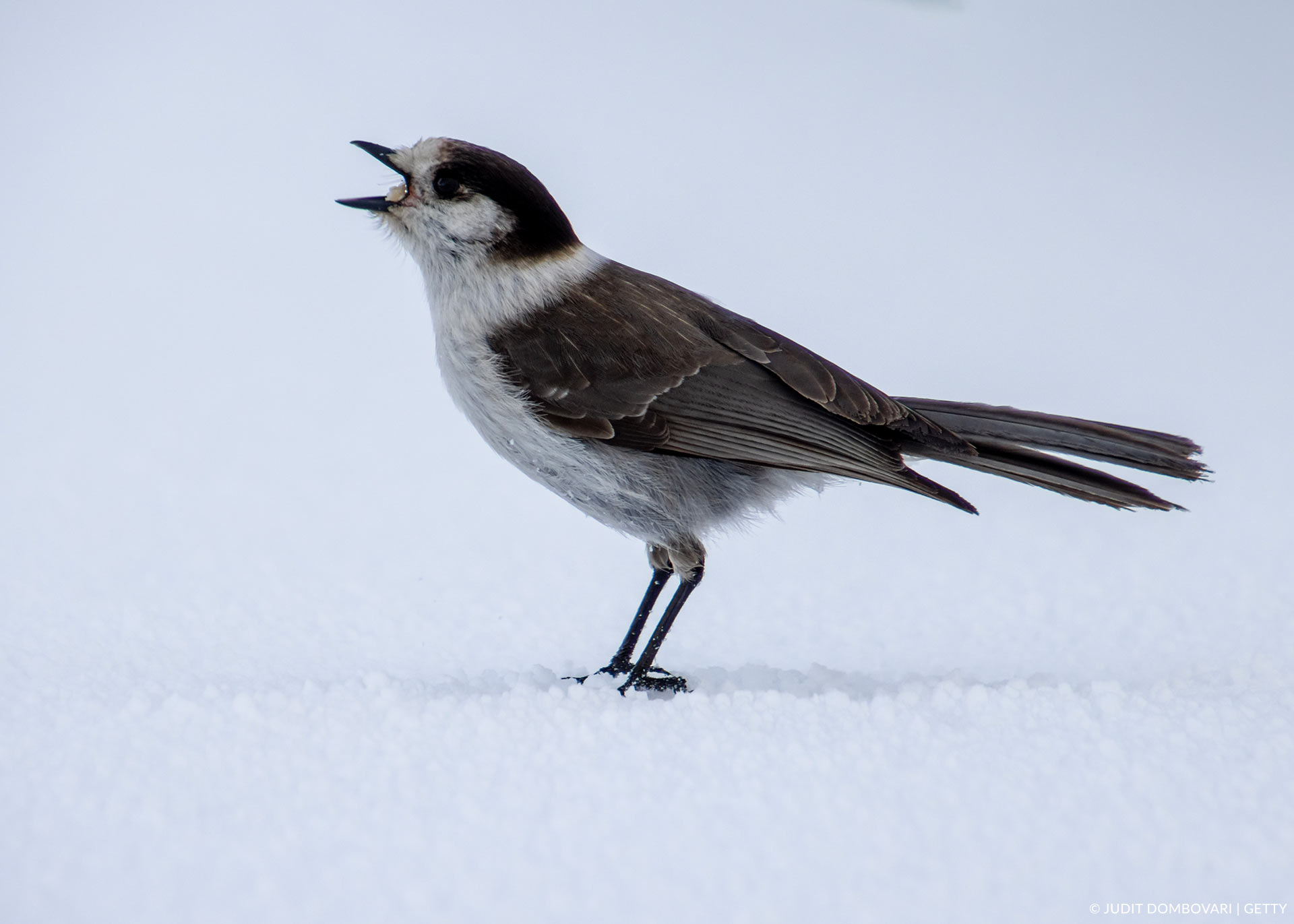
 Credit: Judit Dombovari / Getty
You can find the Canada Jay in a variety of northern coniferous forests. There is strong correlation with the presence of Black Spruce, White Spruce, Engelmann Spruce, Jack Pine, or Lodgepole Pine, and it prefers habitats cold enough to conserve its hidden food over long periods of time.
Remarkably, wherever they occur, even in the extreme north or close to the tree line in the highest mountains, Canada Jays are permanent residents. All year long, mated pairs occupy territories of about 65 to 140 hectares, often sharing them with an extra, nonbreeding jay that is usually one of their young from their previous nesting. Territory-holding adults do not migrate, even for short distances, and the rare fall movements sometimes reported from south of the breeding range probably involve young birds that have not yet acquired a territory of their own.
Because almost all Canada Jays stay in one place and do not have to face the perils of long annual migrations, they often live a very long time for such a small bird. Territory-owning individuals have an average lifespan of about eight years and some jays reach the age of 17 years. Even more remarkable, of the few deaths that occur every year among territory-owning Canada Jays, most happen in summer (probably because of migratory hawks like Merlins and Sharp-shinned Hawks). As puzzling as it may be, long northern winters are apparently no problem for the Canada Jay!
Range
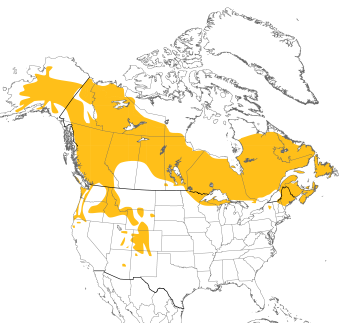
The Canada Jay is found from coast to coast, in all 13 provinces and territories, and from the tree line in the far north, south to the last isolated spruce bogs at the edge of farm country, not far from many of our southern towns and cities. Canada Jays occur in three distinct forms. In southeastern B.C., Canada Jays of the “Rocky Mountain” form have a “white-headed” appearance because the black patch on the back of the head does not extend as far forward as the eyes. In southwestern B.C., including Vancouver Island, Canada Jays of the “Pacific” form have more extensive dark on the head, a pale breast, and numerous white streaks in their back plumage. Everywhere else in their vast range, Canada Jays belong to the “Boreal” form, the one most people are familiar with. Unless otherwise noted, the Boreal form is the one illustrated in the present fact sheet.
Feeding
 Credit: Nelli Siaveleva
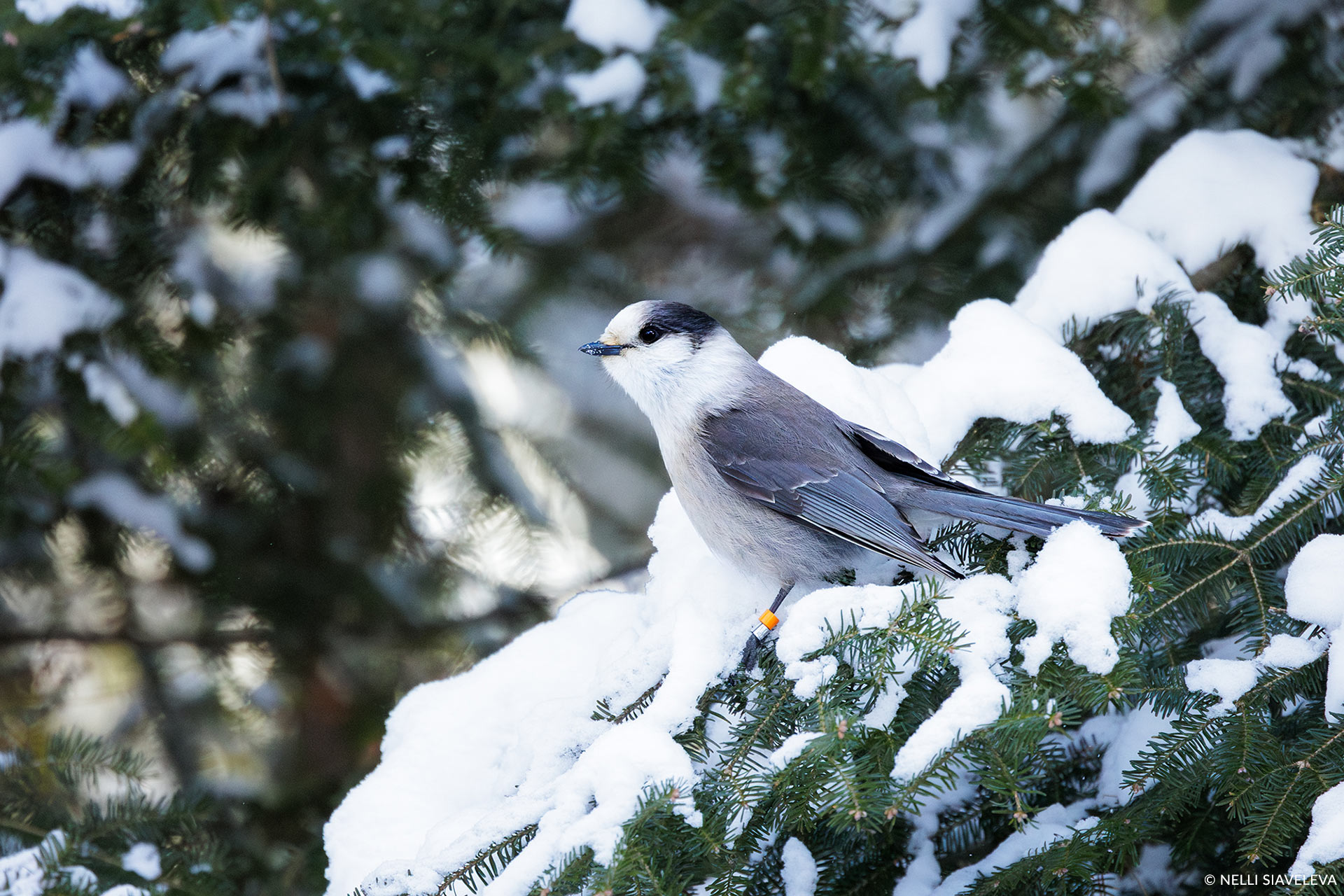
It comes as a surprise to most people, but Canada Jays eat very few non-perishable foods such as seeds. Instead, they eat mostly perishable foods including insects and spiders, berries, the occasional small mammal or amphibian, carrion, bird eggs and nestlings, and fungi.
Canada Jays find these foods by slowly moving through the forest as a pair or family group, pausing frequently on mid-level perches to scrutinize the forest floor and surrounding trees. Very little escapes their sharp eyes and they usually find any new food on their territories (such as dead animals) within a few hours at most. They are also ready to capitalize on any sudden opportunity that may present itself. They will snap up flying insects just like a flycatcher, quickly pounce on a mouse or shrew that ventures out into the open, and rapidly learn that human activity provides a wide variety of strange but nourishing foods.
 Credit: Don White / Getty
It’s all very well that Canada Jays eat a tremendous variety of foods, but that doesn’t explain how they can get away with spending long boreal winters on permanent territories and do so with extremely high survival rates. The secret of the Canada Jay’s success is food storage. Any food beyond a jay’s immediate needs is worked back and forth in the bird’s mouth so that the morsel becomes covered with sticky saliva from its greatly enlarged salivary glands. Thus prepared, the food is stuck behind a piece of bark, under some lichen, or in almost any other conceivable nook or cranny somewhere up in the trees. During long summer days near the Arctic Circle, a food-storing Canada Jay may make up to 1,000 caches a day. It thus accumulates, over the short season of plenty, the food stores that it will need for the following seven or eight months of otherwise stark winter.
Canada Jays guard against theft by covering up their food stores with pieces of bark or lichen and placing them as evenly as possible throughout the forest. They do not pack them into single hiding places like hollow trees or even put them close together in the same general area. Spreading out the food caches prevents disastrous losses of large amounts of food to other Canada Jays or different animals that might happen to find a given hiding place. It also discourages competitors from looking for more food that might be hidden nearby. Astonishingly, it seems that Canada Jays actually remember where they have hidden their individual food caches, and this is how they recover their caches and survive the winter without migrating. No human could ever accomplish such a feat, but several lines of evidence suggest that Canada Jays do exactly that.
Breeding
 Credit: Maïna Percolas
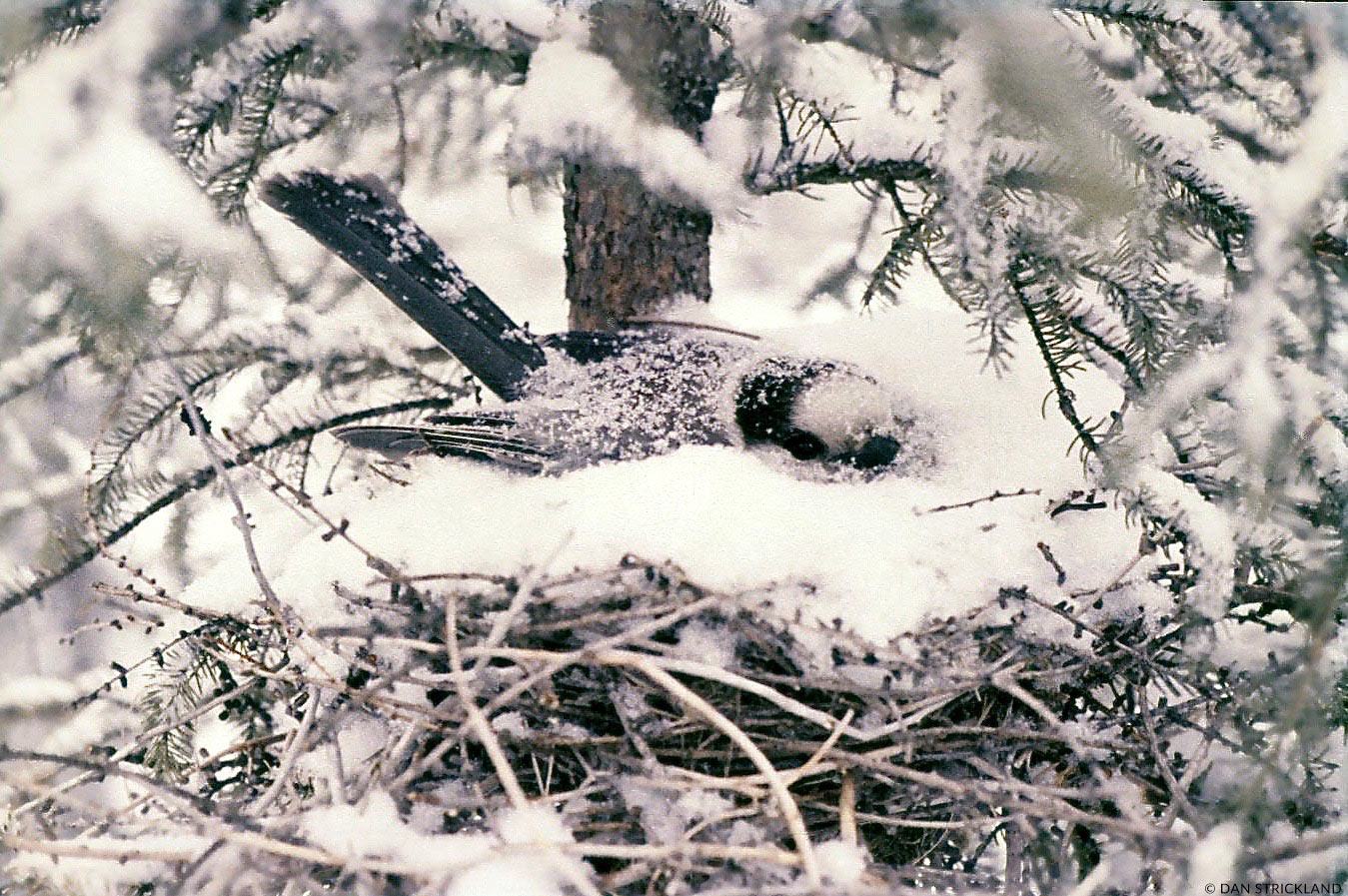
Canada Jays nest extraordinarily early in the year. Nest-building may start in February when there may be a metre of snow on the ground. In the southern part of the Canada Jay’s range, eggs are laid on average around March 21; hatch around April 10; and the young leave the nest around May 1—well before most migratory birds have even returned to the boreal forest, let alone begun to nest themselves. The sight of a female Canada Jay snuggled down on her eggs in 30 below weather, or of jay parents feeding nestlings in the middle of a raging blizzard, is among the most amazing spectacles of nature.
 Credit: Dan Strickland
Several things make early nesting possible. Canada Jay nests are large and well insulated thanks, in part, to hundreds of cocoons that fill in the interstices of the bulky platform of dry dead twigs. Close to the centre are finer twigs, strips of bark, arboreal lichens, and finally, lining the cup itself, several hundred grouse feathers or an equivalent amount of hair or fur. The cup is just large enough to contain the body of the female and two to five eggs (but most often three). Whether it is built close to the trunk of a spruce or fir or out on a long branch, the nest is almost always on the south side of the tree, within one metre of the outside tips of the tree’s foliage, and very often on the north side of a clearing, creek edge, or some similar break in the forest. This means the nest and the incubating female receive a little more direct sunlight than might otherwise be the case.
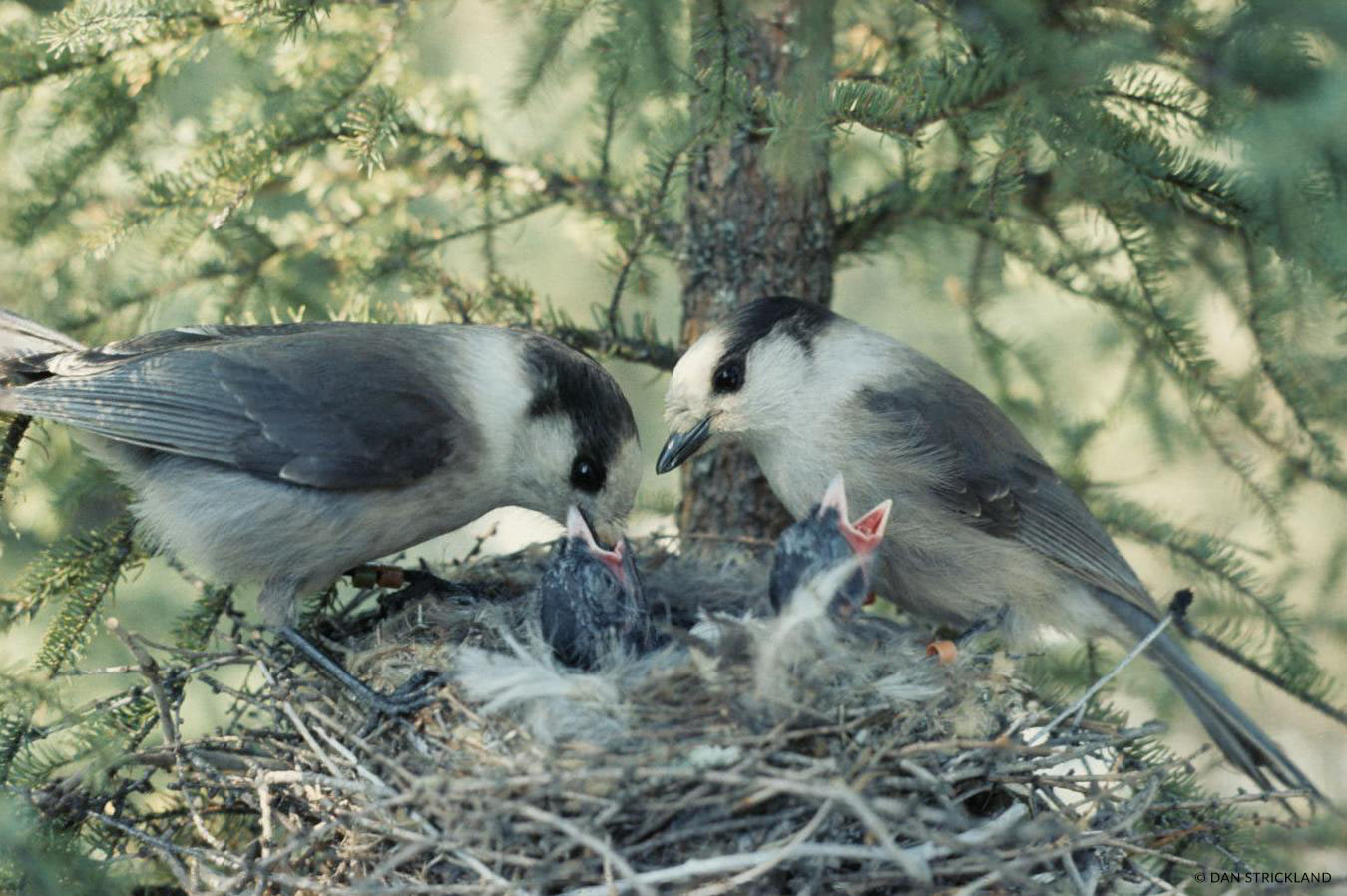
Unlike most other birds, a female Canada Jay sits on her nest beginning with the first egg, apparently to keep it from freezing. True incubation starts when the last egg is laid and, 18 days later, all the eggs hatch within a few hours of each other. At first, the male brings all the food for the nestlings. They hatch as tiny pink nestlings, their backs thinly covered by grey, wispy down. The female broods over them for the next week or so, after which they are big and well feathered enough that she can start accompanying the male on his foraging trips. The parents gather food until their bulging throats can hold no more and then they silently glide to the nest to feed the young. By maximizing their food loads, the adults keep their flights to the nest down to an absolute minimum (about once an hour). This helps keep the nest location a secret from Red Squirrels, a common and dangerous nest predator in Canada Jay country. For the same reason, the adults prevent any nonbreeding Canada Jay on their territory (such as one of their young from the year before) from ever going to the nest. Nonbreeders are thus prevented from helping to feed the young—although they are allowed to do so after the young leave the nest. (Red Squirrels are not a significant threat to flying young so it doesn’t matter after nest-leaving time if the young receive many noisy feeding visits from adults and nonbreeders). The young can normally fly by the time they are 21 days old but they usually stay in the nest for another two or three days. Late departure means the young are more capable fliers when they finally do leave. This probably lessens the chances of a crash landing on melting snow or, worse, in the icy meltwater that often floods spruce bogs in late April.
The most important thing that Canada Jays do in order to succeed in their late winter nesting is to store food the previous summer and fall. Although some insect life becomes available on warm, sunny days in April, there can be no doubt that previously stored food provides, at the very least, a sort of “bad weather insurance.” This allows Canada Jay parents to undertake the huge, energy-demanding task of reproduction at a time of year when the forest contains almost no obvious food supply. But explaining how Canada Jays get away with nesting so early is not nearly as important as explaining why they do it. Why don’t Canada Jays nest in May and June the way other boreal forest birds do? Wouldn’t they produce more surviving young if they timed their nesting to coincide with the annual peak in insect abundance?
 Credit: Dan Strickland
The answers to these questions may lie with the fact that early-nesting Canada Jays can invest more food storage effort in their territories than hypothetical late-nesting pairs. Accumulating the largest possible food stores may be crucial in allowing Canada Jays to have enough stored energy to last all winter. This means they can stay at home and avoid having to migrate and to expose themselves to the terrible dangers of travelling long distances through unfamiliar country. Thus, even if early-nesting Canada Jays cannot produce as many young per year as they would by nesting in warmer weather, they probably still produce more young over their entire lifetimes. This is simply because they live longer and get to breed more times than if they nested late (but also had to migrate and therefore died, on average, at a younger age). Seen in this light, it is only partly true that food storage is what allows early nesting to succeed. It may be even truer to say that early nesting is what allows food storage to succeed!
 Credit: Brittany Crossman/Getty
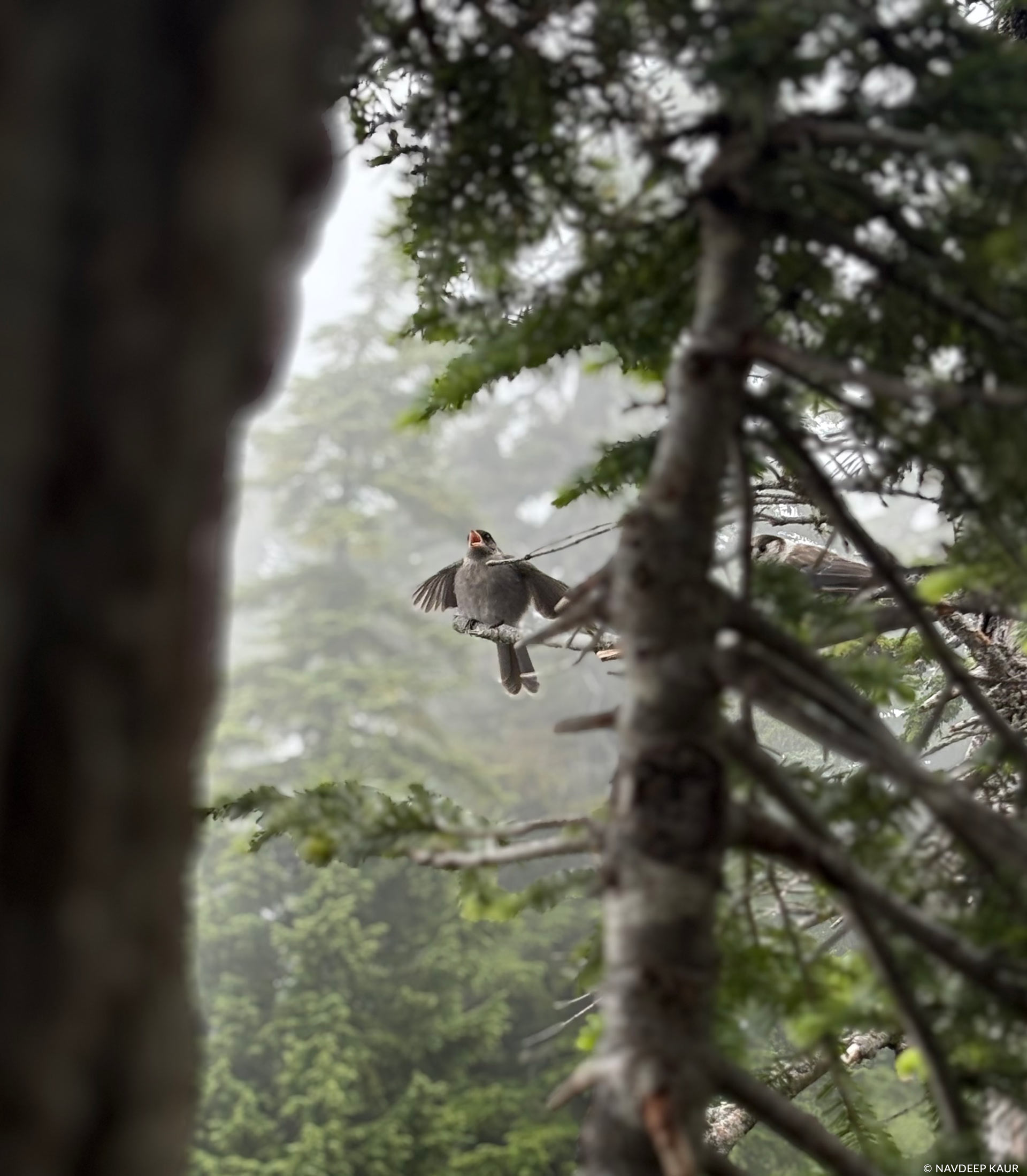
When young Canada Jays leave the nest at 23 days of age, they are well feathered (though short-tailed) and they can fly quite well. For their first two weeks out of the nest, however, they spend most of the time sleeping in thickly foliaged conifers, often huddled together on the same branch. When they hear their parents approaching, they spring to life and, with flapping wings, gaping red mouths, and sustained squalling notes, they vie with each other for some of the incoming food. Bouts of feeding are followed by exercise and perch changes, and sometimes by a series of short flights totalling 100 metres or so before they settle down and wait for the next food delivery.
By the time the young are 44 days old (about 21 days after leaving the nest), they are truly skilful fliers and their tails are full-grown. From then on, they almost always accompany the adults through the forest. Although they relentlessly beg for food, at this point they start to pick up food by themselves—and even store it. The parents then feed them less and less and, by 50 days old, the young are nutritionally independent. In the continent-spanning Boreal form of the Canada Jay, this sets the stage for a radical new development in the fledglings’ lives. Between the ages of 55 and 65 days, the young increasingly fight among themselves and one eventually succeeds in expelling its former nest-mates from the natal territory. Henceforth the dominant juvenile (a male in 75 per cent of cases) will accompany its parents alone through the summer, fall and winter of its first year. As for the ejected birds (the majority of which are females), they quickly leave, and a few succeed in attaching themselves to unrelated pairs, particularly those that have failed in their own nesting that year. Most ejected juveniles aren’t so lucky, however. Sixty per cent of them are dead by their first autumn, as opposed to only 20 per cent of the dominant juveniles that get to stay with their parents and benefit from their example and protection.
 Credit: Hugues de Milleville
The nonbreeding Canada Jays that survive stay on their natal or adoptive territories and use them as a safe base from which to search the surrounding country for a newly opened vacancy in the resident breeding population. When they find one, they quickly move in and replace the former breeder. Members of a mated pair usually stay on the same territory for the rest of their lives. When one of the pair dies, it too is quickly replaced by another bird from the local nonbreeding population.
Conservation
 Credit: Navdeep Kaur
Canada Jays occupy a vast range across the boreal and subalpine forests of North America. Much of this habitat remains intact, but ongoing forestry, mining and energy development continue to alter landscapes throughout their range. Although Canada Jays can persist in disturbed areas and may recolonize regenerating forests, recovery is often slow and may not fully offset habitat loss or degradation. Canada Jays are also occasionally caught in traps set for furbearing mammals. While such incidents are relatively uncommon, their effects may be locally important where trapping activity is widespread.
 Credit: Nina Stavlund
Climate change is emerging as one of the most significant challenges facing Canada Jays. Human activities have increased the concentration of carbon dioxide and other greenhouse gases in the atmosphere, contributing to global warming. Canada Jays rely on food caches to survive winter and to begin breeding while snow still covers the ground. Researchers have suggested that warmer autumn and winter conditions, particularly more frequent freeze-thaw events, may reduce the quality of stored food by promoting spoilage or altering its nutritional value. Some studies have linked warmer temperatures and changing winter conditions to reduced reproductive success and population declines, although the exact mechanisms remain an active area of research. Ontario’s Algonquin Provincial Park is home to the longest-running field study of Canada Jays ever undertaken, and this research has documented a decline of over 80 per cent in the local population since the 1980s. While climate change is thought to be an important factor contributing to these declines, scientists continue to investigate how changing environmental conditions affect Canada Jay survival and reproduction. As the climate continues to warm, Canada Jays may face increasing challenges in the southern portions of their range.
Resources
Wildlife Species Canada:` https://wildlife-species.canada.ca/bird-status/dist-dist-eng.aspx?sY=2019&sL=e&sB=GRAJ&sM=a&sD=7393
All About Birds, Gray Jay: https://www.allaboutbirds.org/guide/gray_jay/id
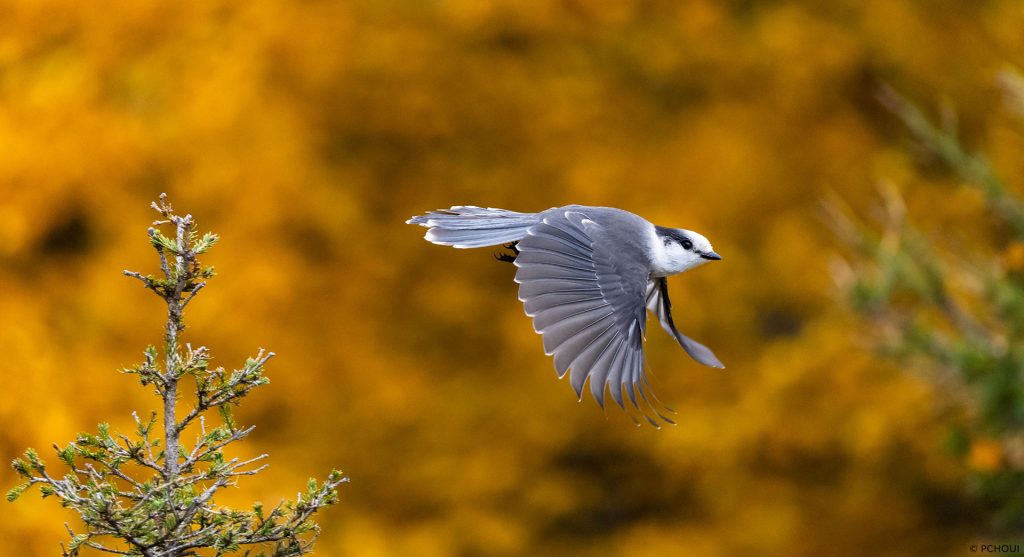 Credit: PchouiAudubon Field Guide, Gray Jay: https://www.audubon.org/field-guide/bird/canada-jay
BirdWeb, Gray Jay: https://birdweb.org/birdweb/bird/gray_jay
Bird, David et al. 2022. The Canada Jay: The National Bird of Canada? Hancock House Publishers, Surrey, BC.
Strickland, D. 2017. How the Canada Jay lost its Name and why it Matters. Ontario Birds 35:2-16.
Strickland, D. and H. R. Ouellet 2020. Canada Jay (Perisoreus canadensis), version 1.0. In Birds of the World (P. G. Rodewald, Editor). Cornell Lab of Ornithology, Ithaca, NY, USA. https://doi.org/10.2173/bow.gryjay.01
Strickland, D. and S.M. Doucet. 2021. A bird that changes colour without moulting: how the wîskicâhk (Canada Jay, Perisoreus canadensis) tricked the taxonomists. Can. J. Zool. 99: 183-195.
Text revised by Dan Strickland, 2026