


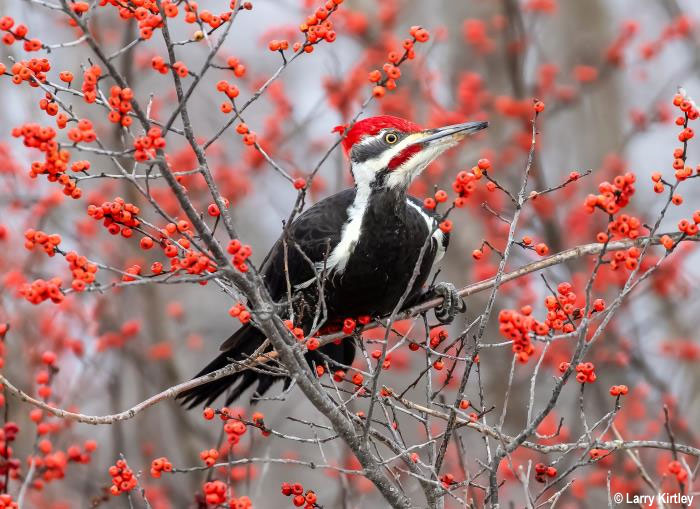
 This bird:
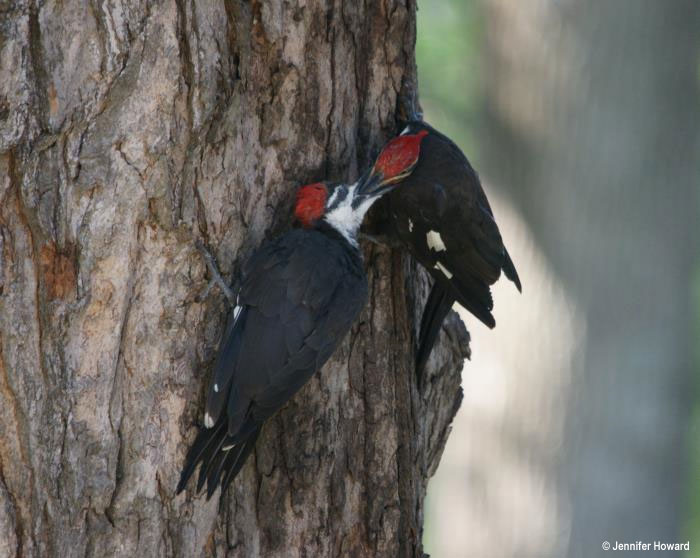
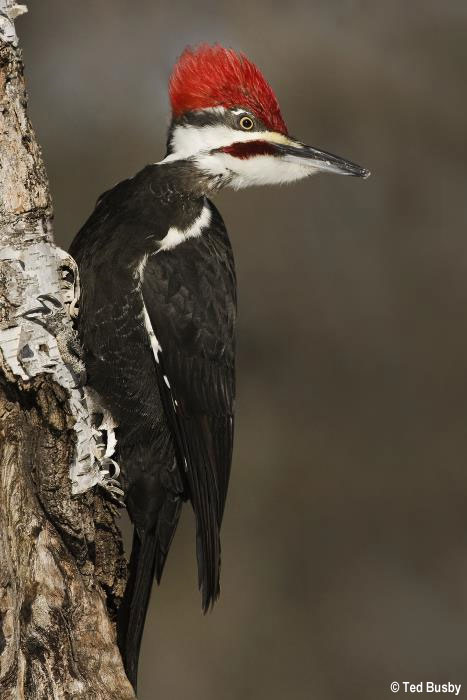
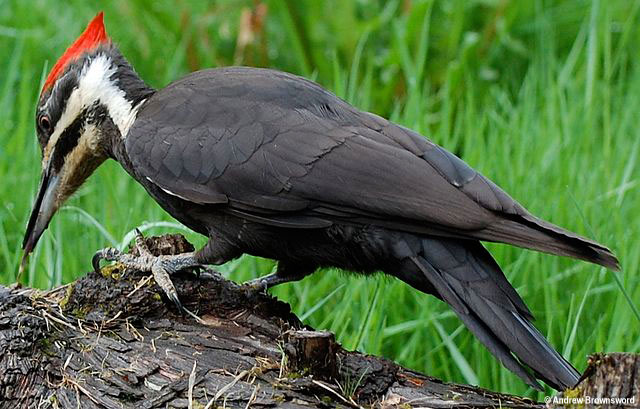
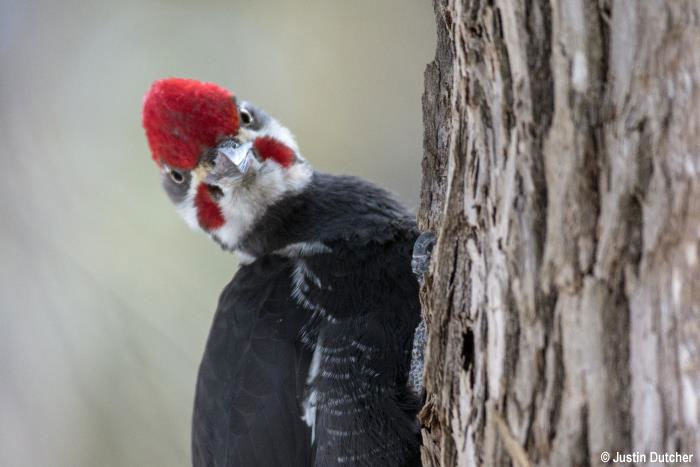

 Pileated Woodpecker (15 sec)
Description
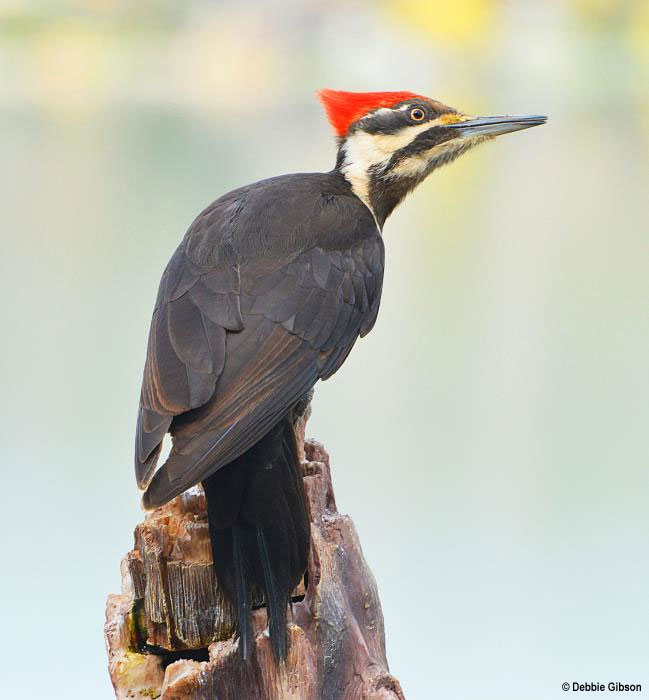
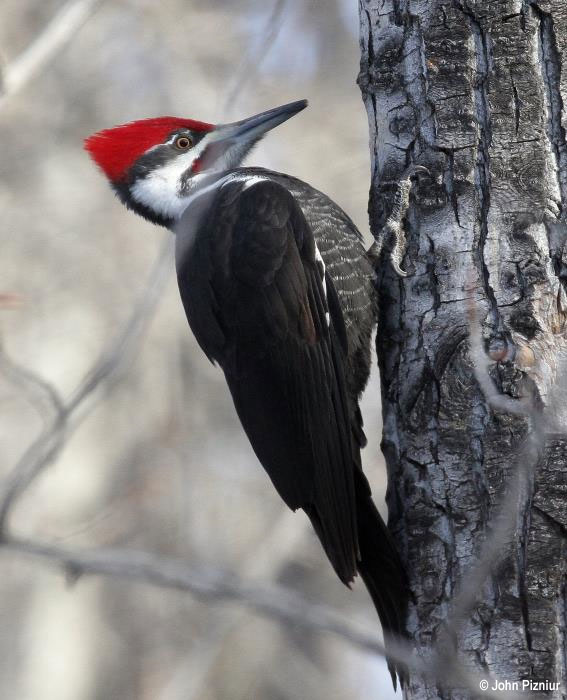
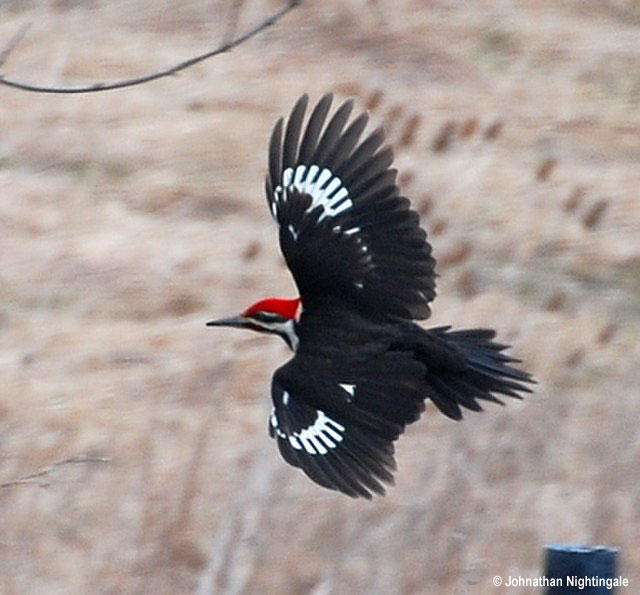
The Pileated Woodpecker (Dryocopus pileatus) is Canada’s largest woodpecker, measuring 40 to 49 centimetres in length with a wingspan of up to 75 centimetres. Adults weigh between 250 and 350 grams. Both sexes are primarily black with bold white stripes running from the bill down the neck and large white wing patches visible in flight.
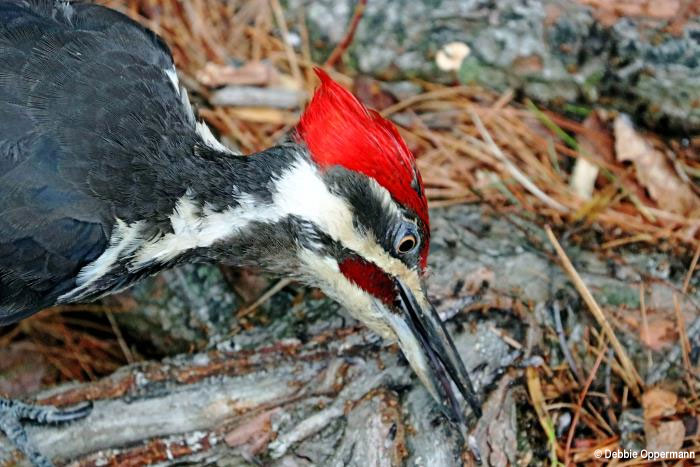
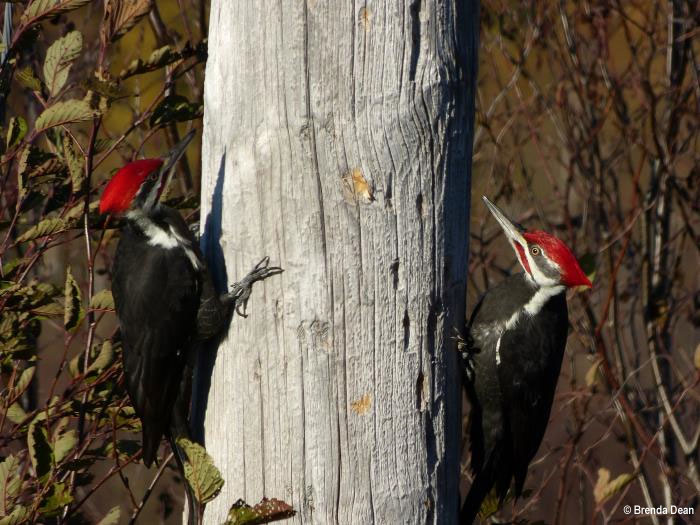
The most distinctive feature is the bright red crest. In males, a red stripe extends from the bill down the cheek, while females have a black stripe in this area, otherwise the sexes look similar. The bird’s long, chisel-like bill is slate-grey and extremely strong, adapted for excavating deep cavities in solid wood.
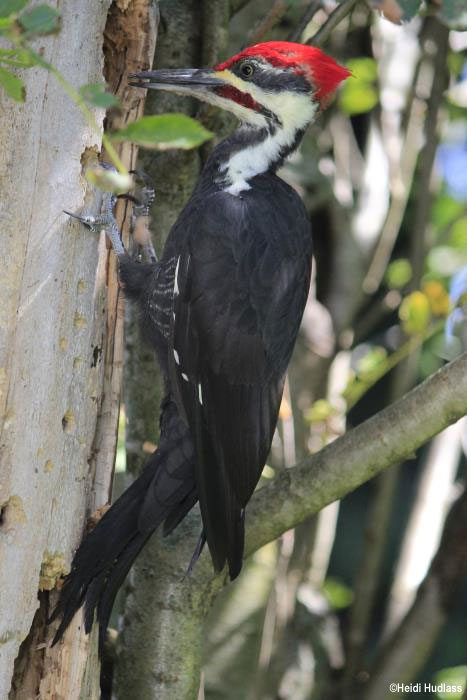
Pileated Woodpeckers have reinforced skulls and specialized shock-absorbing tissues that protect the brain during powerful hammering. Their stiff tail feathers act as a brace against tree trunks, while strong feet with sharp claws provide stability on vertical surfaces. The tongue is exceptionally long and barbed, capable of extending far beyond the bill to extract insects from deep tunnels.
Habitat and Habits
Pileated Woodpeckers inhabit mature and old-growth forests, particularly those containing large trees and abundant standing dead wood, known as snags. These forest features are essential for feeding, nesting and roosting, as the species depends on deep, decaying wood to access insect prey and excavate large cavities. They occur in both coniferous and mixed forests, including coastal temperate rainforests, boreal forests and mature deciduous woodlands, where forest structure is complex and undisturbed.
In Canada, Pileated Woodpeckers are most strongly associated with forests dominated by Douglas-fir, Western Red-cedar, spruce, pine, maple and beech. Along the Pacific coast, they thrive in ancient cedar and hemlock forests rich in dead wood, while in central and eastern Canada they are common in mixed hardwood stands that include large maples and beeches. Although Pileated Woodpeckers will forage in younger or regenerating forests – particularly where fallen logs and stumps are present – they rely on older forest stands for nesting and long-term shelter. Large trees provide the height, diameter and decay conditions required to excavate secure nest cavities that can be reused or abandoned for other wildlife.
Pileated Woodpeckers are generally year-round residents, maintaining permanent territories that may exceed 400 hectares, depending on food availability and forest quality. These territories are actively defended, especially during the breeding season. Outside of nesting, individuals are usually solitary or found in pairs, though family groups may remain together for several weeks after young fledge.
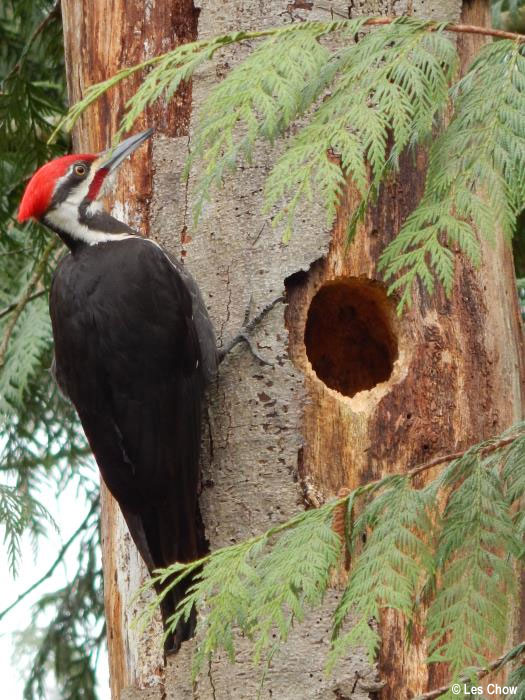
Their presence in a forest is often revealed by the large, rectangular holes they carve into trees and logs, which are distinctive excavations that no other North American woodpecker produces. These holes can be several centimetres wide and deep enough to expose ant colonies or beetle larvae hidden beneath the bark.
Communication plays an important role in Pileated Woodpecker behaviour. They use loud, ringing calls to maintain contact and defend territory, along with visual displays such as crest-raising, wing spreading and bill pointing. Drumming produced by rapid strikes on resonant wood or hollow trunks is primarily a territorial signal rather than a feeding behaviour. The slow, powerful cadence of their drumming can carry long distances through forested landscapes, announcing the presence of one of Canada’s most iconic woodland birds.
Range
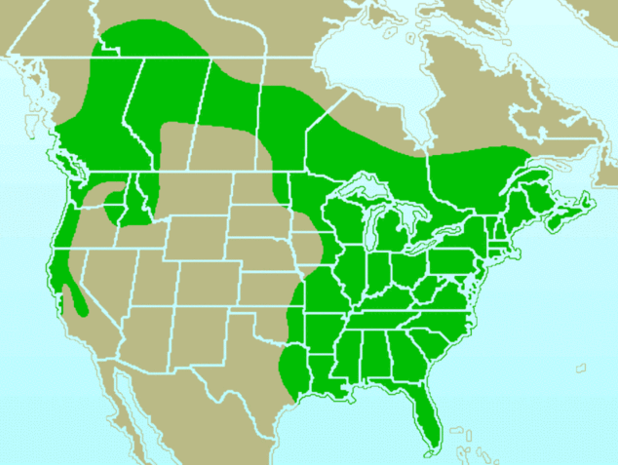
The Pileated Woodpecker is widely distributed across southern Canada, occurring from coastal British Columbia eastward to Newfoundland and Labrador. Its range closely follows the availability of mature forest, particularly areas with large trees and abundant dead wood. The species is absent from the far north, where trees become too small or sparse to support its nesting and foraging needs.
In British Columbia, Pileated Woodpeckers are common in coastal temperate rainforests and throughout the southern Interior, especially in old-growth and mixed forests. Across the boreal forest belt, they are present wherever mature stands persist, though populations become more scattered toward the northern edge of the boreal zone. In the Prairie provinces, the species is largely confined to wooded river valleys, forested uplands and parkland regions where sufficient tree cover exists.
In central and eastern Canada, Pileated Woodpeckers are widespread throughout the Great Lakes–St. Lawrence forest region and the Appalachian forests of the Atlantic provinces. They are well established in southern Ontario and Quebec and extend into New Brunswick, Nova Scotia and Newfoundland, where mature forests provide suitable habitat.
Pileated Woodpeckers are non-migratory and typically remain within the same territory year-round. While individuals may shift short distances in response to storms, forest disturbance or seasonal food availability, they do not undertake long-distance movements. Their strong attachment to established territories means that population changes often reflect long-term forest conditions rather than short-term environmental fluctuations.
Feeding
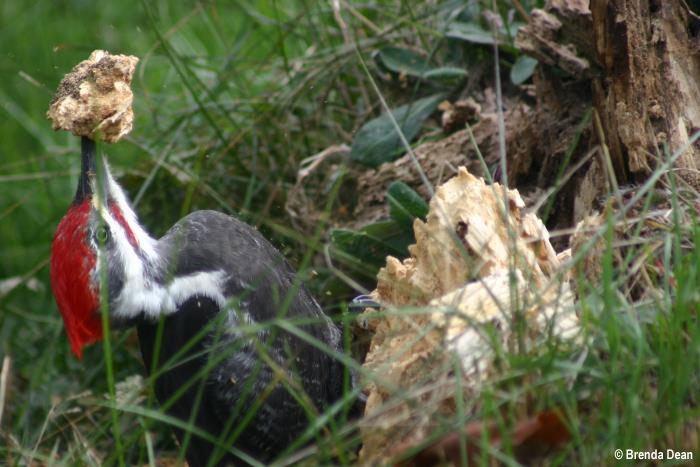
Pileated Woodpeckers feed primarily on wood-dwelling insects, with carpenter ants forming the single most important component of their diet. They also consume beetle larvae, termites and other insects found deep within decaying wood. Their powerful bills allow them to excavate large sections of tree trunks, logs and stumps to access prey that is unavailable to smaller woodpecker species.
Foraging often leaves behind distinctive rectangular holes that expose insect galleries beneath the bark. These excavations not only provide food for the woodpecker but also create access points later used by other birds and mammals. Pileated Woodpeckers typically forage alone, methodically moving across tree trunks and fallen logs while probing for signs of insect activity.
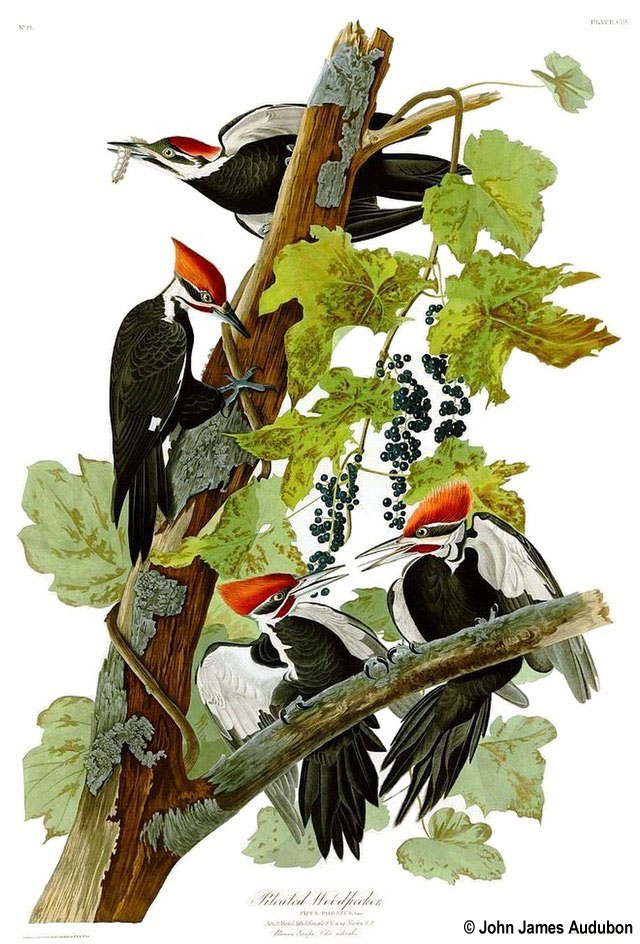
Although insects dominate their diet, Pileated Woodpeckers are seasonally flexible feeders. In late summer and autumn, they supplement their diet with fruits and nuts, including wild cherries, grapes, dogwood berries and sumac. These plant foods provide important energy reserves, especially as insect availability declines during colder months.
Pileated Woodpeckers feed throughout the year and do not store food. Instead, they rely on their ability to locate insect colonies even in winter, often chiselling through frozen bark to reach ants sheltered deep within wood. This specialized feeding strategy allows them to remain resident in northern forests year-round and reinforces their role as a key regulator of forest insect populations. In fact, the Pileated Woodpecker consumes large amounts of the larvae of very destructive invasive insects such as the Emerald Ash Borer and the Mountain Pine Beetle. Signs of increased woodpecker feeding activity can even alert scientists to population increases in problematic insect species.
Breeding
Pileated Woodpeckers form long-term pair bonds and typically breed once per year. Courtship begins in late winter or early spring and includes drumming, calling and visual displays such as head bobbing and crest raising. These behaviours help reinforce pair bonds and establish breeding territories.
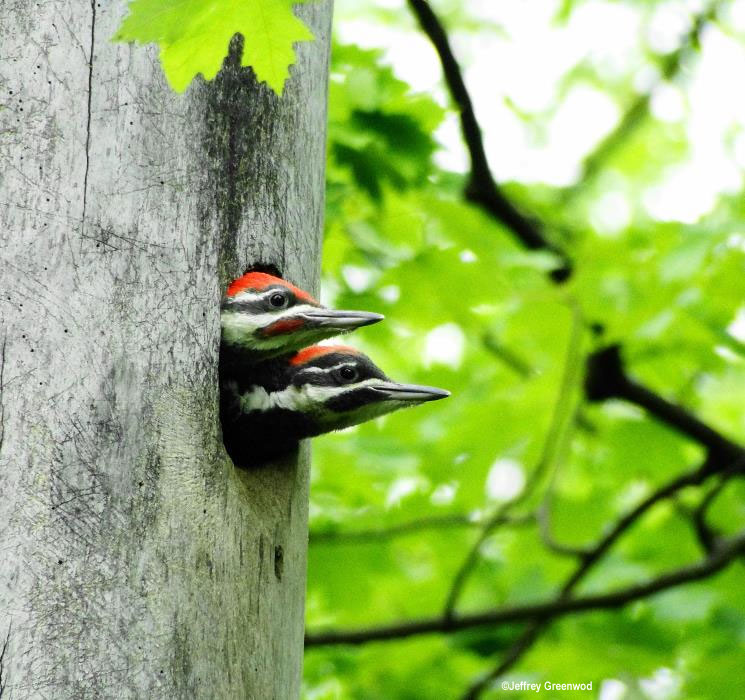
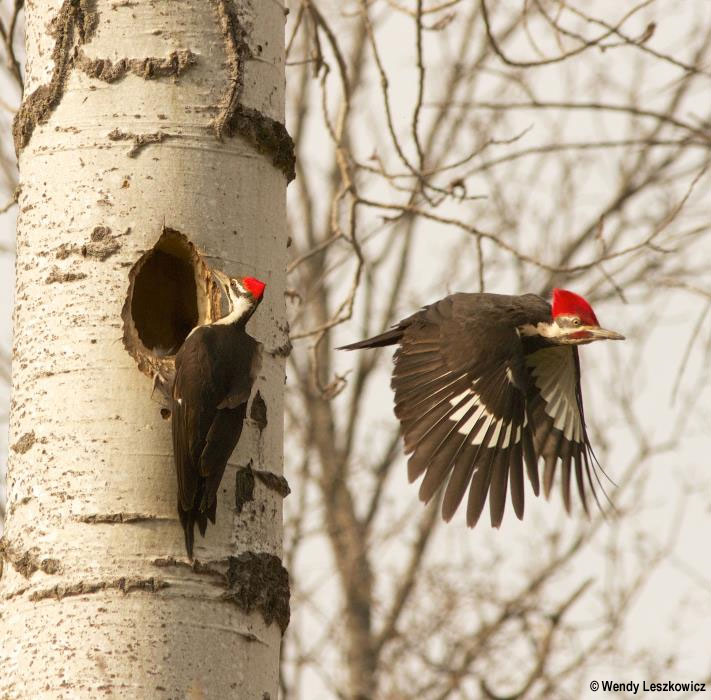
Nesting cavities are excavated in large dead or decaying trees, often at heights of five to 15 metres above the ground. Both the male and female share excavation duties, using their powerful bills to carve out deep, oval-shaped cavities. Suitable nest trees usually show signs of internal decay, making excavation easier while still providing structural stability. New cavities are often created each year, though older cavities within the territory may still be used for roosting.
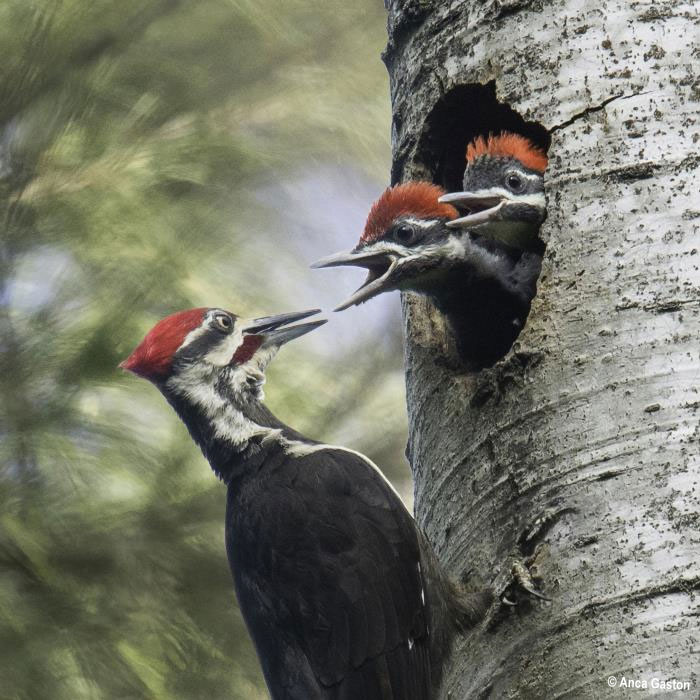
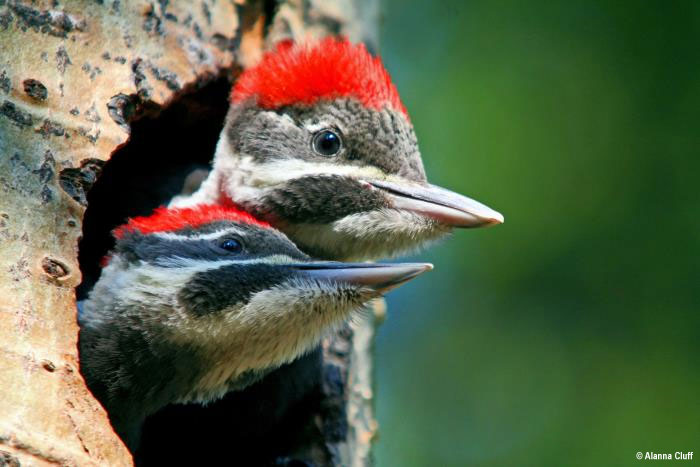
The female lays three to five white eggs, which are incubated by both parents for about 18 days. After hatching, the nestlings are fed regurgitated insects, primarily ants and beetle larvae. Young birds fledge after approximately 26 to 28 days but remain dependent on their parents for several weeks as they learn to forage independently. Most young disperse from the natal territory by late summer or early autumn.
Conservation
The Pileated Woodpecker is currently not considered at risk in Canada, and populations are generally stable. In some regions, numbers have increased as forests regenerate following earlier periods of extensive clearing. Despite this overall stability, the species remains sensitive to changes in forest structure and management practices.
The primary threat to Pileated Woodpeckers is the loss of mature and old-growth forests, particularly the removal of large trees and standing dead wood. Intensive logging, urban expansion and land clearing reduce the availability of nesting and foraging sites. Because Pileated Woodpeckers require large territories and specific habitat features, they may be slow to recolonize in heavily disturbed areas.
Forest management practices that retain snags, large-diameter trees and patches of older forest are essential for maintaining healthy populations. As a species strongly associated with complex forest ecosystems, the presence of Pileated Woodpeckers is often used as an indicator of forest health and biodiversity.
The Pileated Woodpecker has long been recognized by Indigenous peoples as an important forest species. In many cultures, woodpeckers are associated with persistence, communication and the rhythms of the natural world.
Their loud drumming and distinctive calls have featured in oral traditions as signals of seasonal change and forest vitality. Feathers were sometimes used for decoration, while the bird’s behaviour served as a reminder of the importance of respecting trees and forest ecosystems.
Historically, the species suffered declines as old-growth forests were cleared for agriculture and settlement. Its recovery in parts of Canada reflects changing attitudes toward forest conservation.
People most often notice Pileated Woodpeckers through their dramatic excavations and loud drumming. The large holes they carve into trees can sometimes bring them into conflict with homeowners when birds excavate near buildings or wooden structures. However, these behaviours are a natural part of the species’ feeding and nesting habits and are essential to forest ecosystems.
Pileated Woodpeckers play a crucial role as ecosystem engineers. Their abandoned nest cavities are used by more than 40 other species, including owls, wood ducks, bats, squirrels and martens. By creating these cavities, Pileated Woodpeckers increase habitat availability for many forest-dwelling animals that cannot excavate their own nesting sites.
Beyond their ecological role, Pileated Woodpeckers are valued by birdwatchers, naturalists and forest users as symbols of wild, mature forests. Their presence often signals that a forest has retained key structural features such as large trees and dead wood. Protecting habitat for Pileated Woodpeckers therefore benefits not only the species itself, but also a wide range of wildlife and the people who value healthy, diverse forest landscapes.
What we can do
You can help protect the Pileated Woodpecker by supporting healthy forest ecosystems:
- Protect large trees and snags whenever it is safe to do so
- Support sustainable forestry practices that retain old-growth features
- Respect nesting sites, especially during spring and early summer
- Learn and share knowledge about the importance of woodpeckers in forest ecosystems
Resources
- Birds Canada. (2023). Pileated Woodpecker (Dryocopus pileatus). Birds Canada Species Profile.
- Bull, E.L., & Jackson, J.A. (2011). Pileated Woodpecker (Dryocopus pileatus). In A. Poole (Ed.), The Birds of North America Online. Cornell Lab of Ornithology.
- Environment and Climate Change Canada. (2022). Status of Birds in Canada: Pileated Woodpecker. Government of Canada
- NatureServe. (2023). Dryocopus pileatus – Pileated Woodpecker. NatureServe Explorer.
- Parks Canada Agency. (2021). Forest Birds of Canada: Pileated Woodpecker. Government of Canada.
- Poole, A. (Ed.). (2005). The Birds of North America: Pileated Woodpecker. Cornell Laboratory of Ornithology, Ithaca, New York.
- U.S. Forest Service. (2006). Pileated Woodpecker Habitat Management Guidelines. USDA Forest Service Technical Report.
- British Columbia Ministry of Forests. (2020). Wildlife Habitat Conservation: Pileated Woodpecker. Government of British Columbia.
- Hinterland Who’s Who. (2023). Pileated Woodpecker. Canadian Wildlife Service and Canadian Wildlife Federation. www.hww.ca
Text by Jody North, 2026